NOTE: Don't take this post too seriously. Though it isn't a joke.
I really don't like sex to be in shonen and seinin manga. Heck, I don't like it in pretty much all media that has a story to it, but for this post I'm going to focus on shonen and seinen manga. Also, since this is a pretty touchy subject, I'm going to try to keep this pretty concise.
So, here's my problem: I hate the way sex in used in shonen and seinen manga. And here are the reasons why:
My main problem comes from the fact that sex is always used to simply make a male character look more manly. Now, often this doesn't involve the main protagonist, but that doesn't change the fact that I hate when its done, as it is still a weak and stupid way to portray a man's "manliness". Sex determining "maniliess" is for the animal kingdom, not humans who have the ability to see the "cheapness" of the way sex is portrayed. One of the first examples of this I came across was in Eyeshield 21 with the character of Agon being introduced before the game between the Devil Bats and the Nagas; he's introduced on a bed getting dressed while a girl in a towel is cleaning up int he bathroom. Agon is also constantly portrayed flirting with many, many women throughout the series; all of them falling for him without a second thought. This leads to my second problem ....
Sex in shonen and seinen manga demeans women a great deal. Almost 100% of the time, we don't know who the woman/women are, and they are present simply for the male character to have sex with and nothing else; usually just getting tossed away right afterwards. It shows that the male character(s), as well as the mangaka, simple see the women as sex objects and nothing more. It comes across as childish and just a really weak way of telling a story; even if the tone of the story is dark. Even when a manga/anime's tone isn't dark, this type of action where women are basically seen as objects so a man can look more manly can be found in acts that aren't sex; most often, it's seen through the sexual harassment of female characters, often main female characters; this can be seen a lot in the manga/anime Fairy Tail and Rave Master.
On the subject of the women, this leads to the next point: sex in shonen and seinen manga/anime is never consensual. The woman is either being used by the man for sex, being raped, being forced into the act due to being a servant, or simply being a slut. All of these situations don't create any type of situation I would find necessary for a story or being good for character development. It's just smut, and smut's only place is in porn.
Now let's flip the coin, where we have extremely promiscuous women. The most recent that come to mind are Panty from "Panty & Stocking" and Zero from the soon-to-be-released "Drakenguard 3". These types of characters do nothing for story or character development; they are simply sluts. Why have such a character? To prove a point? With Zero, I can see the developers try to create a dark and depressing story for the character of Zero, but it will still feel unnecessary to me. And the reason for that is ...
Sex in shonen and seinen is unnecessary. Sex never brings about character development, even when dealing with adult characters or dark tones; it's always done simply to portray a male character as "manly" or a female character as "slutty", or create a dark tone or atmosphere. Such things can be done in much better ways through actual story telling and use of dialogue and actions, as shown by the many great manga which have no such elements of sex. As a result, I can only see the existence of sex in shonen and seinen manga to be for the factor of fanservice and smut; that's what it ultimately be viewed as, either that or simply to create a terrible feeling of dread in the reader/watcher, and if that was the case, there are far better ways of doing that.
And, I suppose that's where I end this. I realize this may sound hypocritical since I enjoy several fanservice series. But fanservice does not equal sex. To me, sex is a level that is reserved only for porn; it has no place in good story telling. Though, I will say that several series come close to crossing the line between fanservice and sex, such as the aforementioned Fairy Tail. Now, I realize this is a rather fickle subject to talk about, as I avoid series that have such sexual content, and there are far more series that don't have sexual content than one's that do. Perhaps that's why I get so worked up when I see such series, especially when they gain such popularity. Though I can see where the smut factor comes into place there.
::sigh::, I know, I know; this was a stupid post, but I've just been seeing too much smut lately. Now, if you'll excuse me, I'm rewatching Nichijou.
Showing posts with label Opinion. Show all posts
Showing posts with label Opinion. Show all posts
Monday, June 24, 2013

Sunday, June 16, 2013
Should "fun" be a requirement for videogames?
As I watch playthroughs of The Walking Dead and The Last of Us, the same thought keeps popping up in my head: why would I ever want to play this?
I thought about why I think this, and I believe it's because I don't see a shred of fun in either game. And this got me to thinking: should "fun" be a requirement for videogames?
Now, of course, there are videogames that have less-than-stellar game design that result in them no being very fun, but at least the developers intention was to have the game be fun. But, with the games: The Walking Dead and The Last of Us, they look, imo, to be made intentionally not to be fun. Now, this lack of fun is to drive home the horror experience and help deliver the heavy themes of the story home better; I understand this execution, and I also respect it, as both games deliver very impactful experiences. However, was it "wrong" for the developers to do so with a videogame? Well, according to every professional videogame critic on the internet: no, but here's my interpretation ...
Videogames are an artform, but they are a specific type of artform, just as movies, paintings, music, etc. are a specific type of artform. Each of them has specific factors that they must contain to be part of their artform; for example, paintings need a canvas, music needs sound, and movies need film (I know there are exceptions to this rule, like that silent orchestra thing, but bear with me). And videogames, at their core, are games that need to be played. Perhaps I am too narrow minded, but I feel that the concept of "play" directly coincides with "fun"; and thus, videogames should require some sort of fun factor. A factor I just don't see in The Walking Dead and The Last of Us. The reason being that both games directly go out of their way to make sure you understand how heavy the themes of the story are and that your actions should be taken seriously; whether it be seeing the consequences of your actions play out in often gruesome fashion in The Walking Dead, or Ellie's consistent disgusted reactions to Joel's killing of people; there is no "fun" element to be found.
Other videogames that go for the "visual experience" execution of gaming have similar ideas; such as how Yorda shrieks in fear when Ico gets hurt, or how Snake will throw up if he's killed a lot of soldiers in MGS4. But the difference between these games and The Walking Dead/The Last of Us, is that games like Ico, the MGS series, Odin Sphere, Journey, Shadow of the Colossus, and Killer7, is that, despite having an execution that drives home various heavy themes, they are still all very much videogames; as they have elements such as puzzles, combat mechanics, collecting, etc. Things that make them feel very much like videogames; things that give them a "fun factor". And while The Last of Us does have elements such as combat and collecting, they aren't present to neccessarily reward skill, but rather push the player to kill in a different manner; simply a means to an end to drive home the tone of the story.
So what does this all mean? Well, both The Walking Dead and The Last of Us have been not only universally praised, but hailed as new steps in gaming. And if I were to ask myself why these games were being praised as such, I'd think it was because of they'er lack in fun. Because, without that "fun factor" both games have achieved something else, something beyond simple gaming. I suppose I'd say they may have transcended the videogame artform and become something else. A fusion of videogame and film perhaps? A videogame that can actually criticize and judge on its own merits perhaps?
Whatever these two games accomplished, its impressive. However, was it worth it? Is it worth losing the factor of fun, the core essence of videogames, to become something greater?
This laid-back guy says "No!". I know I'm just a simple guy, so my opinion means close to nothing, but I'd just thought I'd put it out there. Videogames can be amazing experiences, but, at their core, there should always be some fun to be had. If not, then I feel that the videogame loses what makes videogames so unique. An experience that brings us joy and entertainment through means that no other artform can provide: fun and immediate interaction.
I thought about why I think this, and I believe it's because I don't see a shred of fun in either game. And this got me to thinking: should "fun" be a requirement for videogames?
Now, of course, there are videogames that have less-than-stellar game design that result in them no being very fun, but at least the developers intention was to have the game be fun. But, with the games: The Walking Dead and The Last of Us, they look, imo, to be made intentionally not to be fun. Now, this lack of fun is to drive home the horror experience and help deliver the heavy themes of the story home better; I understand this execution, and I also respect it, as both games deliver very impactful experiences. However, was it "wrong" for the developers to do so with a videogame? Well, according to every professional videogame critic on the internet: no, but here's my interpretation ...
Videogames are an artform, but they are a specific type of artform, just as movies, paintings, music, etc. are a specific type of artform. Each of them has specific factors that they must contain to be part of their artform; for example, paintings need a canvas, music needs sound, and movies need film (I know there are exceptions to this rule, like that silent orchestra thing, but bear with me). And videogames, at their core, are games that need to be played. Perhaps I am too narrow minded, but I feel that the concept of "play" directly coincides with "fun"; and thus, videogames should require some sort of fun factor. A factor I just don't see in The Walking Dead and The Last of Us. The reason being that both games directly go out of their way to make sure you understand how heavy the themes of the story are and that your actions should be taken seriously; whether it be seeing the consequences of your actions play out in often gruesome fashion in The Walking Dead, or Ellie's consistent disgusted reactions to Joel's killing of people; there is no "fun" element to be found.
Other videogames that go for the "visual experience" execution of gaming have similar ideas; such as how Yorda shrieks in fear when Ico gets hurt, or how Snake will throw up if he's killed a lot of soldiers in MGS4. But the difference between these games and The Walking Dead/The Last of Us, is that games like Ico, the MGS series, Odin Sphere, Journey, Shadow of the Colossus, and Killer7, is that, despite having an execution that drives home various heavy themes, they are still all very much videogames; as they have elements such as puzzles, combat mechanics, collecting, etc. Things that make them feel very much like videogames; things that give them a "fun factor". And while The Last of Us does have elements such as combat and collecting, they aren't present to neccessarily reward skill, but rather push the player to kill in a different manner; simply a means to an end to drive home the tone of the story.
So what does this all mean? Well, both The Walking Dead and The Last of Us have been not only universally praised, but hailed as new steps in gaming. And if I were to ask myself why these games were being praised as such, I'd think it was because of they'er lack in fun. Because, without that "fun factor" both games have achieved something else, something beyond simple gaming. I suppose I'd say they may have transcended the videogame artform and become something else. A fusion of videogame and film perhaps? A videogame that can actually criticize and judge on its own merits perhaps?
Whatever these two games accomplished, its impressive. However, was it worth it? Is it worth losing the factor of fun, the core essence of videogames, to become something greater?
This laid-back guy says "No!". I know I'm just a simple guy, so my opinion means close to nothing, but I'd just thought I'd put it out there. Videogames can be amazing experiences, but, at their core, there should always be some fun to be had. If not, then I feel that the videogame loses what makes videogames so unique. An experience that brings us joy and entertainment through means that no other artform can provide: fun and immediate interaction.
Friday, May 24, 2013
The After-Effects of Watching the Gurren Laggan Movie
So, I watched the first Gurren Laggan movie, and I didn't like it, at all. Previous to me wathcing this movie, I had a generally positive opinion of Gurren Laggan. I had watched around 10 episodes of the anime, and seen some of the latter action in spurts, and my opinion then was: I may not like the characters, but the action is amazing, and this may be the best looking anime out there. However, after watching the first GL movie, I've come to realize some things about the series and the animation studio, as well as come to experience and appreciate other series.
First, I'll say what I think of GL and Gainax (specifically, director Hiroyuki Imaishi) after watching the movie. Basically, I have come to have almost zero interest in this series, and where I used to really appreciate and anticipate works from Gainax, and now Trigger, I know have much less appreciation, and, dare I say, respect for the studio. While a lot of this harsh criticism comes from how intense the fanboyism of this series is (including my own brother), most comes from the series content. First of all, and most importantly, the characters of GL are terrible, just terrible. Simon is boring and his story couldn't feel more by-the-books, Kamina is an unlikable idiot who may talk big, but rarely ever backs up his grand words with actions. Yoko might as well be named "Girl", as she does nothing but what a child would expect a girl to do in a manly story like GL, stand around, be sexy, and become the hero's girlfriend. Nia is only present to be a plot device as well as be a girlfriend for Simon. And the supporting cast is forgettable, however, I'd say a few of them are more likable than the main cast.
Now, the reason I bring up the characters is because they are the main reason for me not liking what everyone loves about GL: the over-the-top action. I've realized something after watching the GL movie, and that is that action, no matter how intense or "big", completely lacks impact if the characters behind those actions are terrible. And, I've come to realize that this is a big reason why I don't like any of Gainax's works, because I simply don't like the characters. And, well, that's that. There are other reasons I really didn't like GL, such as the poorly executed setting, poorly developed villains, and the over-excessiveness of "manly" visuals (I hate that Dai-Gurren's bow is basically a giant penis). But, honestly, its the poor characters that always stick out the most to me.
And, after I realized that, I'd come to another realization: the only reason I wanted to like GL so much, even after disliking it before, was because of all the hype around the anime, and the fact that it was in a genre I really liked and the animation style was unique. It was this pressure that made me feel like I had to like anime. And that's why I watched the GL movie. However, after watching the movie I came to many realizations:
1) Gurren Laggan is basically trying to be Getter Robo (the 90s OVAs to be specific), and failing hard at it. Getter Robo has much better characters, a much better realized setting, and the visual style has much more "oomph" thanks to the strong manga-like animation. The action in Getter Robo is also much better thanks to the great characters backing up that action. Still, I think it's a shame things turned out the way they did in GL, as Imaishi is a fan of Getter Robo, and GL was to be his homage to the series.
2) Gainax's animation isn't nearly as impressive as it once was; mainly due to the Getter Robo OVAs looking much better, and they were made long before GL. I will admit that the first 5-minute sequence of the GL movie was beautiful, and I wish the whole movie looked like that, but alas it didn't. And, that's another thing, I've noticed that GL really only looks good at certain parts, specifically, the action scenes, but other anime like Shin Getter Robo Armageddon, Nichijou, Madoka Magica, and Katanagatari look great throughout their entire lengths rather than at certain scenes. The bottom-line is that I gave Gainax far too much credit before. Their work can still be impressive at times, but its really not that impressive.
3) Gurren Laggan is a poor coming-of-age story. It even pales in comparison to FLCL, which was a decent coming-of-age story, even if it has far too much innuendo. However, I've experienced far, far superior coming-of-age stories before, specifically the manga Eyeshield 21, which I've been re-reading lately. After reading Eyehshield 21 again, I've come to realize how poor GL's writing is, and that if Gainax would stop trying to be so over-the-top and immature about their stories, they could actually tell some good ones.
All-in-all, watching the GL movie has come to make me appreciate what I had before, and that I really don't need to like Gurren Laggan despite what my friends, family, and the internet have to say. Because, I simply don't like it, for many reasons, and I have much, much better alternatives to GL, such as Getter Robo, Astro Boy, Eyeshield 21, and One Piece. Gainax used to hold a special place in my heart when it came to anime, despite me not really liking any of their series; it stood upon a pedestal that it could not be moved from, but no longer. And I'm happy about that, as it's allowed me to place other manga and anime upon that pedestal position it once held, and thus allowed me appreciate the strengths of other anime and manga, specifically, Shin Getter Robo Armageddon, which is a series that I really didn't appreciate enough.
First, I'll say what I think of GL and Gainax (specifically, director Hiroyuki Imaishi) after watching the movie. Basically, I have come to have almost zero interest in this series, and where I used to really appreciate and anticipate works from Gainax, and now Trigger, I know have much less appreciation, and, dare I say, respect for the studio. While a lot of this harsh criticism comes from how intense the fanboyism of this series is (including my own brother), most comes from the series content. First of all, and most importantly, the characters of GL are terrible, just terrible. Simon is boring and his story couldn't feel more by-the-books, Kamina is an unlikable idiot who may talk big, but rarely ever backs up his grand words with actions. Yoko might as well be named "Girl", as she does nothing but what a child would expect a girl to do in a manly story like GL, stand around, be sexy, and become the hero's girlfriend. Nia is only present to be a plot device as well as be a girlfriend for Simon. And the supporting cast is forgettable, however, I'd say a few of them are more likable than the main cast.
Now, the reason I bring up the characters is because they are the main reason for me not liking what everyone loves about GL: the over-the-top action. I've realized something after watching the GL movie, and that is that action, no matter how intense or "big", completely lacks impact if the characters behind those actions are terrible. And, I've come to realize that this is a big reason why I don't like any of Gainax's works, because I simply don't like the characters. And, well, that's that. There are other reasons I really didn't like GL, such as the poorly executed setting, poorly developed villains, and the over-excessiveness of "manly" visuals (I hate that Dai-Gurren's bow is basically a giant penis). But, honestly, its the poor characters that always stick out the most to me.
And, after I realized that, I'd come to another realization: the only reason I wanted to like GL so much, even after disliking it before, was because of all the hype around the anime, and the fact that it was in a genre I really liked and the animation style was unique. It was this pressure that made me feel like I had to like anime. And that's why I watched the GL movie. However, after watching the movie I came to many realizations:
1) Gurren Laggan is basically trying to be Getter Robo (the 90s OVAs to be specific), and failing hard at it. Getter Robo has much better characters, a much better realized setting, and the visual style has much more "oomph" thanks to the strong manga-like animation. The action in Getter Robo is also much better thanks to the great characters backing up that action. Still, I think it's a shame things turned out the way they did in GL, as Imaishi is a fan of Getter Robo, and GL was to be his homage to the series.
2) Gainax's animation isn't nearly as impressive as it once was; mainly due to the Getter Robo OVAs looking much better, and they were made long before GL. I will admit that the first 5-minute sequence of the GL movie was beautiful, and I wish the whole movie looked like that, but alas it didn't. And, that's another thing, I've noticed that GL really only looks good at certain parts, specifically, the action scenes, but other anime like Shin Getter Robo Armageddon, Nichijou, Madoka Magica, and Katanagatari look great throughout their entire lengths rather than at certain scenes. The bottom-line is that I gave Gainax far too much credit before. Their work can still be impressive at times, but its really not that impressive.
3) Gurren Laggan is a poor coming-of-age story. It even pales in comparison to FLCL, which was a decent coming-of-age story, even if it has far too much innuendo. However, I've experienced far, far superior coming-of-age stories before, specifically the manga Eyeshield 21, which I've been re-reading lately. After reading Eyehshield 21 again, I've come to realize how poor GL's writing is, and that if Gainax would stop trying to be so over-the-top and immature about their stories, they could actually tell some good ones.
All-in-all, watching the GL movie has come to make me appreciate what I had before, and that I really don't need to like Gurren Laggan despite what my friends, family, and the internet have to say. Because, I simply don't like it, for many reasons, and I have much, much better alternatives to GL, such as Getter Robo, Astro Boy, Eyeshield 21, and One Piece. Gainax used to hold a special place in my heart when it came to anime, despite me not really liking any of their series; it stood upon a pedestal that it could not be moved from, but no longer. And I'm happy about that, as it's allowed me to place other manga and anime upon that pedestal position it once held, and thus allowed me appreciate the strengths of other anime and manga, specifically, Shin Getter Robo Armageddon, which is a series that I really didn't appreciate enough.
Sunday, May 5, 2013
My Favorite Character Designs - Special Round: Boobs are Cool
So, this post is going to be weird. Weird even for me. I mean it. I'm gonna say "boobs" a lot, and its gona be weird for both of us. Though I will say that this post will still be "safe for work"; well, except for all the art of busty characters. Anyway ... in light of the recent attacks against the character designs of Dragon's Crown, I got to thinking why I like so many character designs of women that have large breasts. And, well, the answer was simple: because big boobs can be pretty cool, and I'll explain why while showing some of my favorite large breasted characters.
Now, I'll address the big "note" to attach to this post: when I say "boobs are cool", I'm speaking about art, specifically drawings, animation, and all stuff encompassing fantasy,sci-fi, or simply fake stuff. I'm not speaking about real life, where this topic would be highly inappropriate, heh. So, c'mon, I'm a nice guy, and I wouldn't want to insult anyone. Actually, I find that if most critics would first think to themselves: "This isn't real. This is a drawing; a fantasy."; they'd be a lot more understanding of this whole subject matter.
So, why make this post in the first place? Well, because, in past posts and, most likely, in future posts (especially in my "Favorite Character Design" series), I'm going to bring up more large-breasted characters, and I'd like to explain a little bit why I like such character designs. And I'm gonna try to do that here, even though it still probably won't be clear and this may all end up just being pretty weird, heh.
I'll also say this right away: I'm completely aware that "sex appeal" is an element put into all of these character designs, even if I don't mention it. But the reason I like the following designs is because they go beyond the simple and boring execution of just putting large breasts on a character and actually make the designs "cooler" by having large breasts by executing the design in various ways, as I'll explain below.
Also, if you take one look at this article and just say "Nope. They're just big boobs; there's nothing stylish about it." That's fine. Maybe I'm seeing something that's just not there. Regardless, this is why I like these designs; if you have a different opinion, that's fine.
---------------------------------------------------------
Sorceress (Dragon's Crown)

So, I'm just gonna address the two big ones first, as they are hot topics at the moment, and happen to be my two favorite designs in the forthcoming Dragon's Crown. The Sorceress has one of my favorite design styles for buxom characters: the stylish silhouette. By stylish silhouette, I mean that she consists of only a few colors and details; as a result, her hourglass figure is a lot more pronounced and noticeable. It's a simple, yet effective style for these types of characters, as the viewer doesn't have to look for very long to see the character design's appeal. Perhaps the most famous use of this stylish silhouette is the infamous Jessica Rabbit, whose bright red dress accented her figure perfectly. The only thing going against the Sorceress' stylish silhouette style is her exposed cleavage, which draws a bit too much attention to her top half; still, an amazing and effective design.
---------------------------------------------
Amazon (Dragon's Crown)


Angel is a great example of the "fighting boobs" design style. Her moveset is all about movement; from her long punches and kicks to her powerful running and grabbing game; Angel's moves are very accentuated by her body, thus why her design has rather long legs and short hair. So, how does Angel fit into the "fighting boobs" style? Well, because Angel moves around so much, her torso moves a lot as well, and we see her body turn and flow; her large breasts accentuate this "flow" of her body from one move to another. Other KOF ladies have large breasts as well, such as Vanessa and Shermie, but they lack the "fighting boobs" style, as their fighting movements lack a strong "flow". Granted, Angel's breasts aren't very noticeable when fighting, but I can't imagine her attacks looking the same without them.
---------------------------------------------------------
Haruka Gracia (Basquash!!)

Haruka Gracia is one of my all-time favorite character designs. Her long hair, her stylish glasses, her stylish dress, and, most obvious, her large bust. Haruka is a different take on the design of "powerful boobs", as she is not a fighter, yet, thanks to her large bust, she has a powerful presence. This is the design style I believe many designers want to incorporate into their designs, but fail to execute it right because they believe that any female character with a large bust will gain this strong presence, which is definitely not the case. So what makes Haruka have such a presence, well, it's mainly due to the combination of her eyes and her breasts. Similar to Jessica Rabbit and Bayonetta, Haruka's eyes and composure just scream confidence, which allows her to "puff out her chest" both figuratively and literally, thus creating a supreme presence to the character's design from her eyes to her "powerful boobs".
-----------------------------------------------------------
At this point, I believe I've gone over all of the different ways I find boobs to be cool. I understand boobs are mostly always done for fanservice, but it's characters like those I've listed in this post that make large breasts so much more than just fanservice. Boobs can be stylish and cool, just like clothes, weapons, and colors can. It's just all about the execution. And I love me some well-executed boobs.
Now, for some more of my favorite busty character designs, just in a more concise fashion:
Yuugi Hoshiguma

Like a Amazon, a great example of "powerful boobs".
---------------------------------------------------
B. Jenet (Garou: Mark of the Wolves)

One of the best examples of both "powerful boobs" and "fighting boobs". Her animations are still amazing to see to this day; and its thanks to those stylish animations that B. Jenet may be the sexiest girl in gaming.
--------------------------------------------------------------
Daidouji (Senran Kagura)

Perhaps the most defining example of "powerful boobs".
-----------------------------------------------------------
Hilde (Soulcalibur)

Hilde is a rather unorthodox but great example of the "stylish silhouette" execution. While most examples of the "stylish silhouette" are done in a dress of some kind, Hilde pulls it off with armor. As we are most use to seeing men in the usual form of armor, it is oddly alluring to see Hilde in armor that fits her feminine form. Regardless, it's works very well, and has made Hilde one of the more alluring characters in the Soulcalibur roster.
--------------------------------------------------
Arsene (Tantei Opera Milky Holmes)

Arsene is a great example of both "powerful boobs" and "fighting boobs" alongside a bit of humor as well. Her design is one of my all-time favorites as its very stylish, but also humourous, as she is the only busty character in the show, which is constantly played for laughs.
----------------------------------------------------------
Honorable Mention: Rushuna Tendo (Grenadier)

Rushuna Tendo is a strange beast. On one hand, she is the most fanservice-focused character on this list, but on the other hand, she has perhaps the most stylish use for her large bust on the list. So, to just get it out of the way, Rushuna's signature move is her ability to hold bullets within her cleavage, force the bullets out by shaking her breasts slightly, reloading her gun using said bullets, and then shoot her enemies all within one fluid motion. It's a really stylish and cool idea, and I have to give it praise for its originality. Rushuna also shows elements of "fighting boobs", as her fighting style is very acrobatic, and accentuated by her large bust. However, when reading/watching Grenadier, its obvious that her large breasts were also largely for fanservice, as she is not very confident and doesn't have a strong presence. So, while she may not be one of my favorite character designs, I think at least deserves mention.
---------------------------------------------------------------------
Now, don't get me wrong. There are some busty character designs out there I don't like. For example, the manga/anime Fairy Tail is full of busty characters, and I don't like any of their designs except for Erza, and that's only because of her armor ability that constantly keeps the execution of her boobs stylish. Then there's every harem series ever made; don't like any of them. And, you know, I could just go on about this. I've explained my stance on fanservice before, so I won't dwell on it know. I just wish there were more stylish executions of busty characters more.
Now, I'll address the big "note" to attach to this post: when I say "boobs are cool", I'm speaking about art, specifically drawings, animation, and all stuff encompassing fantasy,sci-fi, or simply fake stuff. I'm not speaking about real life, where this topic would be highly inappropriate, heh. So, c'mon, I'm a nice guy, and I wouldn't want to insult anyone. Actually, I find that if most critics would first think to themselves: "This isn't real. This is a drawing; a fantasy."; they'd be a lot more understanding of this whole subject matter.
So, why make this post in the first place? Well, because, in past posts and, most likely, in future posts (especially in my "Favorite Character Design" series), I'm going to bring up more large-breasted characters, and I'd like to explain a little bit why I like such character designs. And I'm gonna try to do that here, even though it still probably won't be clear and this may all end up just being pretty weird, heh.
I'll also say this right away: I'm completely aware that "sex appeal" is an element put into all of these character designs, even if I don't mention it. But the reason I like the following designs is because they go beyond the simple and boring execution of just putting large breasts on a character and actually make the designs "cooler" by having large breasts by executing the design in various ways, as I'll explain below.
Also, if you take one look at this article and just say "Nope. They're just big boobs; there's nothing stylish about it." That's fine. Maybe I'm seeing something that's just not there. Regardless, this is why I like these designs; if you have a different opinion, that's fine.
---------------------------------------------------------
Sorceress (Dragon's Crown)

So, I'm just gonna address the two big ones first, as they are hot topics at the moment, and happen to be my two favorite designs in the forthcoming Dragon's Crown. The Sorceress has one of my favorite design styles for buxom characters: the stylish silhouette. By stylish silhouette, I mean that she consists of only a few colors and details; as a result, her hourglass figure is a lot more pronounced and noticeable. It's a simple, yet effective style for these types of characters, as the viewer doesn't have to look for very long to see the character design's appeal. Perhaps the most famous use of this stylish silhouette is the infamous Jessica Rabbit, whose bright red dress accented her figure perfectly. The only thing going against the Sorceress' stylish silhouette style is her exposed cleavage, which draws a bit too much attention to her top half; still, an amazing and effective design.
---------------------------------------------
Amazon (Dragon's Crown)

The Amazon represents what is probably my favorite design execution of busty character designs, which I'll dub simple as: "powerful boobs". This style is often associate with strong female characters who are often muscular and tall (there will be several more on this list); and it works in a stylish way where the woman's breasts act similar to large pectorals on muscular male designs, as it accentuates the chest of the character thus giving the character design a strong presence. This design works well, imo, because it is the better executed version of what many artists use to try and convey a "powerful female character". What this commonly entails, is a designer simply taking a strong male character and just switching the gender; this often results in characters who are just soulless, and feel like they were created simply because the designers were too scared to make a character like the Amazon. Woman can be muscular, women can be strong; that's what the amazon myth was all about. Anyway, what's great about the Amazon's character design is her lack of clothing, as it really accentuates her muscular body, as none of it is hidden. It's a fearless design, and I love that. Her beauty is also not lost, as she has a gentle face, beautiful golden hair, and a pretty feather in her hair. A powerful yet beautiful design. One of my all-time favorites.
------------------------------------------------------
Tifa (Final Fantasy VII)

Here's a unique design. In the original FFVII game, Tifa fell under the style of "powerful boobs", as her strength was accented through gameplay, and her large breasts felt like a way of showing she had muscle, considering they couldn't exactly show she had muscles on her character model back then. But, in the Advent Children movie, Tifa's breasts, though less accentuated than in the game, executed a different type of style for busty character designs, a style I'll call: "fighting boobs". I call it that because, it's a design style often found with busty character designs who fight. See, during fight scenes a lot of parts of the characters catch our eye: hands, arms, legs, eyes, and, if its long enough, hair. But, sometimes, breasts get added to that list, adding yet another layer to a characters movement during a fight; they're never as noticeable as the arms or legs, but its still a playable element. Tifa may not be the best example, but she has it.
--------------------------------------------------------------
Angel (King of Fighters)

---------------------------------------------------------
Haruka Gracia (Basquash!!)

Haruka Gracia is one of my all-time favorite character designs. Her long hair, her stylish glasses, her stylish dress, and, most obvious, her large bust. Haruka is a different take on the design of "powerful boobs", as she is not a fighter, yet, thanks to her large bust, she has a powerful presence. This is the design style I believe many designers want to incorporate into their designs, but fail to execute it right because they believe that any female character with a large bust will gain this strong presence, which is definitely not the case. So what makes Haruka have such a presence, well, it's mainly due to the combination of her eyes and her breasts. Similar to Jessica Rabbit and Bayonetta, Haruka's eyes and composure just scream confidence, which allows her to "puff out her chest" both figuratively and literally, thus creating a supreme presence to the character's design from her eyes to her "powerful boobs".
-----------------------------------------------------------
At this point, I believe I've gone over all of the different ways I find boobs to be cool. I understand boobs are mostly always done for fanservice, but it's characters like those I've listed in this post that make large breasts so much more than just fanservice. Boobs can be stylish and cool, just like clothes, weapons, and colors can. It's just all about the execution. And I love me some well-executed boobs.
Now, for some more of my favorite busty character designs, just in a more concise fashion:
Yuugi Hoshiguma

Like a Amazon, a great example of "powerful boobs".
---------------------------------------------------
B. Jenet (Garou: Mark of the Wolves)

One of the best examples of both "powerful boobs" and "fighting boobs". Her animations are still amazing to see to this day; and its thanks to those stylish animations that B. Jenet may be the sexiest girl in gaming.
--------------------------------------------------------------
Daidouji (Senran Kagura)

Perhaps the most defining example of "powerful boobs".
-----------------------------------------------------------
Hilde (Soulcalibur)
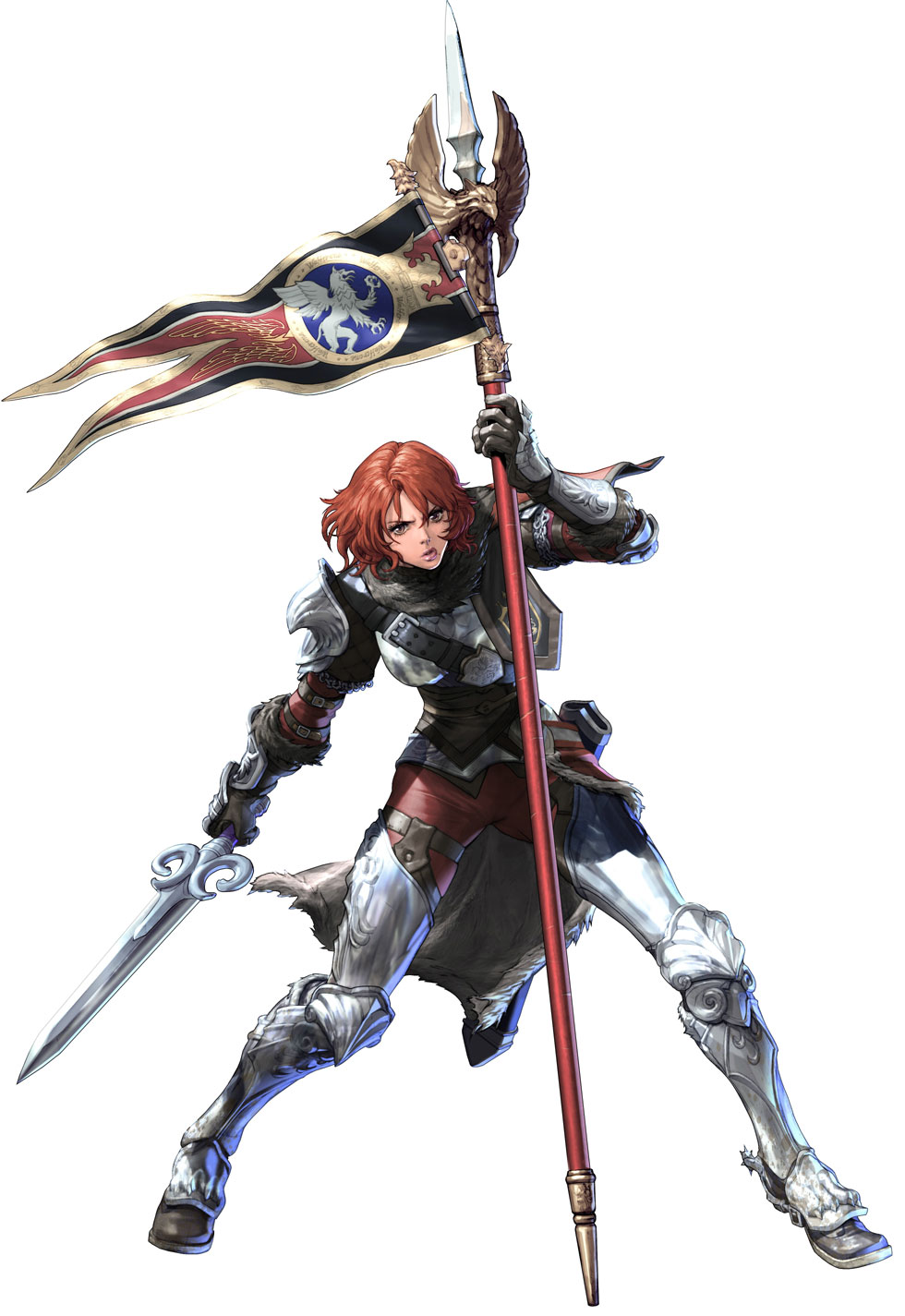
Hilde is a rather unorthodox but great example of the "stylish silhouette" execution. While most examples of the "stylish silhouette" are done in a dress of some kind, Hilde pulls it off with armor. As we are most use to seeing men in the usual form of armor, it is oddly alluring to see Hilde in armor that fits her feminine form. Regardless, it's works very well, and has made Hilde one of the more alluring characters in the Soulcalibur roster.
--------------------------------------------------
Arsene (Tantei Opera Milky Holmes)
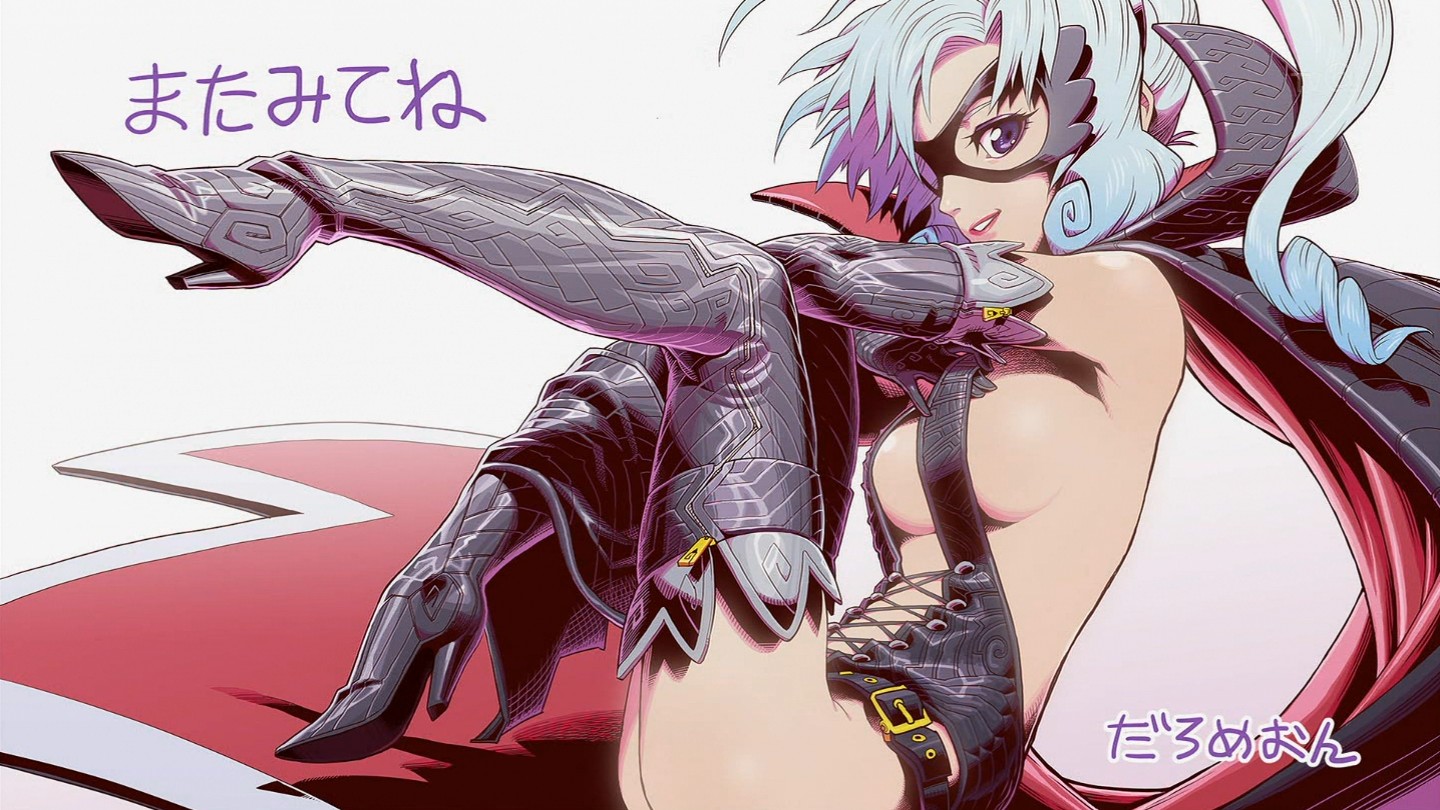
Arsene is a great example of both "powerful boobs" and "fighting boobs" alongside a bit of humor as well. Her design is one of my all-time favorites as its very stylish, but also humourous, as she is the only busty character in the show, which is constantly played for laughs.
----------------------------------------------------------
Honorable Mention: Rushuna Tendo (Grenadier)

Rushuna Tendo is a strange beast. On one hand, she is the most fanservice-focused character on this list, but on the other hand, she has perhaps the most stylish use for her large bust on the list. So, to just get it out of the way, Rushuna's signature move is her ability to hold bullets within her cleavage, force the bullets out by shaking her breasts slightly, reloading her gun using said bullets, and then shoot her enemies all within one fluid motion. It's a really stylish and cool idea, and I have to give it praise for its originality. Rushuna also shows elements of "fighting boobs", as her fighting style is very acrobatic, and accentuated by her large bust. However, when reading/watching Grenadier, its obvious that her large breasts were also largely for fanservice, as she is not very confident and doesn't have a strong presence. So, while she may not be one of my favorite character designs, I think at least deserves mention.
---------------------------------------------------------------------
Now, don't get me wrong. There are some busty character designs out there I don't like. For example, the manga/anime Fairy Tail is full of busty characters, and I don't like any of their designs except for Erza, and that's only because of her armor ability that constantly keeps the execution of her boobs stylish. Then there's every harem series ever made; don't like any of them. And, you know, I could just go on about this. I've explained my stance on fanservice before, so I won't dwell on it know. I just wish there were more stylish executions of busty characters more.
Wednesday, April 10, 2013
My Thoughts on Bioshock Infinite (SPOILERS)
NOTE: I have played through 60% of Bioshock Infinite and have seen about 90% of the game, including the ending. So, keep that in mind while reading this.
So, Bioshock Infinite. It's become one of the highest-rated and most talked about games ever in just a smal amount of time. However, I find the game quite over-rated. Now, before you smack me, let me say that I find BI to be a great game, amazing in some respects, but still over-rated.
Let me say my praises for the game first. First off, the game looks amazing. Sure, NPC models are reused, and enemy models don't look that great, but the environments, Elizabeth, and Songbird all look incredible, and the way they all touch and interact with each other is great as well. Next, I'll say that the execution of the story is a huge step above the original, as now the story plays out right in front of you, and the player feels a lot more engaged because of it. The soundtrack and voice acting are also superb, especially the superb performance from Troy Baker as Booker.
Now, onto my criticisms. Basically, my main gripe (and main reason I chose to wrote this blog) is that BI gets praised for so many things that we've seen or experiences before. The first example being the gameplay: it's the same thing as the first game. Sure, the new zip-line mechanic is cool, but its hardly used; heck, combat as a whole is a pretty small part of the game, which is perhaps why it isn't very deep. Sure, there are the multiple vigors and guns, but each battle plays out in the same fashion: point and shoot. There is little to no variety in the BI's combat, despite the fact that the vigors give you many useful abilities. One could say the controlling of machines is a strong point of the combat, but it quickly becomes dull when controlling the turrets or machines is what you do every time you see one. Same can be said for how to deal with the people. Murder of Crows, Bucking Bronco, or whichever vigor you prefer to use to slow down your enemy so you can shoot them. Overall, combat is just too simple; well, at least too simple to be praised. BI's main focus is the story anyway, so it seems a bit harsh to criticize the gameplay so harshly.
And that brings me to the second point: the story. Two praises the story gets that I find irksome are the beginning and the multiple universes. I'll start with the beginning. The beginning of BI begins with a fair where you can participate in attractions, listen to a barbershop quartet, and even practice combat for later. I'd give this part of the game more praise if I hadn't already experienced it well over a decade ago in Chrono Trigger. Don't get me wrong, it was a really nice way to start the game, but we have to give credit where credit is due, and BI's opening feels practically ripped right out of CT's Millenial Fair opening. And next comes the multiple universes that begin to overlap with each other due to the actions of one man and certain events of the past. Does this sound familiar? Because it's the main plot foundation for Chrono Cross. While BI's ending did eventually make its story more than a rip-off of CC's, I found it quite noticeable.
And third, we come to the setting: the city in the sky run by a tyrannical overlord with kind words but an evil agenda, where people are separated into classes that are forbidden to interbreed, where the people revere their ruler and his offspring as their guiding light, and it all comes crumbling down due to the hubris of the the city's leader and the rebellion of his offspring who once that he controlled through love. Sound familiar?

It's Zeal. It's Zeal to a freakin' T! Now, I'm not saying BI's setting still isn't great, as I especially liked the way it crafted a beautiful utopian version of America in the 1920s. But the similarities to Chrono Trigger most famous arc cannot be denied. Now, I know that there have been many stories in the past that feature cities in the sky, tyrannical overlords, seducing the people with words, etc. But the way they all came together in CT's Zeal arc was an amazing experience back in 1995. I know it probably didn't happen with everyone, but the comparisons hit me pretty early on, and, as a result, I felt the story lost a lit of impact. I'd seen this all before. It also didn't help that the story was pretty predictable, with the exception of the ending (though you could see a lot of elements of that coming too).
Which leads to my last point: the story and characters. The story of BI is perhaps what gets the most praise; particularly, the ending and the character of Elizabeth. The ending was quite good, though it is foreshadowed a lot throughout the game, and we've seen multiple universe stories before, mainly in sci-fi shows, novels, and movies. So, imo, it was entertaining, but nothing groundbreaking. Just because this type of story is put into a videogame doesn't mean its as if we hadn't experienced it before in other mediums. Now to the character of Elizabeth, who I feel was well done, but not nearly as impactful as many make her out to be. Sure, it's nice that she does interesting things like not follow you into the men's bathroom, wait on a bench while your scrounging, or provide lots of expressive facial expressions at key moments, but, besides all that, she never had much of an impact on me. I never felt attached to her. I suppose that's mainly due to the fact that she never feels like she needed Booker's help. She follows you perfectly, takes care of herself in battle, and saves Booker a bunch of times. Now, I like Elizabeth in that she is a strong character, but if the purpose of the game was to make me care about Elizabeth as someone to rescue, I don't think the game accomplished that. ICO executed this perfectly with Yorda; I find that to be the perfect example of a female companion the player bonds with through gameplay and story.
Overall, Bioshock Infinite is a great game, but not a very satisfying one. It executes a lot of its ideas, both gameplay and story, quite well, but it feels like a very limited experience. Combat can only get so deep, how much I care for Elizabeth can only go so far, and the impact of the setting can only tantalize me so much before I fall out of the experience and feel more like I'm watching a decent play rather than experiencing a videogame.
So, Bioshock Infinite. It's become one of the highest-rated and most talked about games ever in just a smal amount of time. However, I find the game quite over-rated. Now, before you smack me, let me say that I find BI to be a great game, amazing in some respects, but still over-rated.
Let me say my praises for the game first. First off, the game looks amazing. Sure, NPC models are reused, and enemy models don't look that great, but the environments, Elizabeth, and Songbird all look incredible, and the way they all touch and interact with each other is great as well. Next, I'll say that the execution of the story is a huge step above the original, as now the story plays out right in front of you, and the player feels a lot more engaged because of it. The soundtrack and voice acting are also superb, especially the superb performance from Troy Baker as Booker.
Now, onto my criticisms. Basically, my main gripe (and main reason I chose to wrote this blog) is that BI gets praised for so many things that we've seen or experiences before. The first example being the gameplay: it's the same thing as the first game. Sure, the new zip-line mechanic is cool, but its hardly used; heck, combat as a whole is a pretty small part of the game, which is perhaps why it isn't very deep. Sure, there are the multiple vigors and guns, but each battle plays out in the same fashion: point and shoot. There is little to no variety in the BI's combat, despite the fact that the vigors give you many useful abilities. One could say the controlling of machines is a strong point of the combat, but it quickly becomes dull when controlling the turrets or machines is what you do every time you see one. Same can be said for how to deal with the people. Murder of Crows, Bucking Bronco, or whichever vigor you prefer to use to slow down your enemy so you can shoot them. Overall, combat is just too simple; well, at least too simple to be praised. BI's main focus is the story anyway, so it seems a bit harsh to criticize the gameplay so harshly.
And that brings me to the second point: the story. Two praises the story gets that I find irksome are the beginning and the multiple universes. I'll start with the beginning. The beginning of BI begins with a fair where you can participate in attractions, listen to a barbershop quartet, and even practice combat for later. I'd give this part of the game more praise if I hadn't already experienced it well over a decade ago in Chrono Trigger. Don't get me wrong, it was a really nice way to start the game, but we have to give credit where credit is due, and BI's opening feels practically ripped right out of CT's Millenial Fair opening. And next comes the multiple universes that begin to overlap with each other due to the actions of one man and certain events of the past. Does this sound familiar? Because it's the main plot foundation for Chrono Cross. While BI's ending did eventually make its story more than a rip-off of CC's, I found it quite noticeable.
And third, we come to the setting: the city in the sky run by a tyrannical overlord with kind words but an evil agenda, where people are separated into classes that are forbidden to interbreed, where the people revere their ruler and his offspring as their guiding light, and it all comes crumbling down due to the hubris of the the city's leader and the rebellion of his offspring who once that he controlled through love. Sound familiar?
It's Zeal. It's Zeal to a freakin' T! Now, I'm not saying BI's setting still isn't great, as I especially liked the way it crafted a beautiful utopian version of America in the 1920s. But the similarities to Chrono Trigger most famous arc cannot be denied. Now, I know that there have been many stories in the past that feature cities in the sky, tyrannical overlords, seducing the people with words, etc. But the way they all came together in CT's Zeal arc was an amazing experience back in 1995. I know it probably didn't happen with everyone, but the comparisons hit me pretty early on, and, as a result, I felt the story lost a lit of impact. I'd seen this all before. It also didn't help that the story was pretty predictable, with the exception of the ending (though you could see a lot of elements of that coming too).
Which leads to my last point: the story and characters. The story of BI is perhaps what gets the most praise; particularly, the ending and the character of Elizabeth. The ending was quite good, though it is foreshadowed a lot throughout the game, and we've seen multiple universe stories before, mainly in sci-fi shows, novels, and movies. So, imo, it was entertaining, but nothing groundbreaking. Just because this type of story is put into a videogame doesn't mean its as if we hadn't experienced it before in other mediums. Now to the character of Elizabeth, who I feel was well done, but not nearly as impactful as many make her out to be. Sure, it's nice that she does interesting things like not follow you into the men's bathroom, wait on a bench while your scrounging, or provide lots of expressive facial expressions at key moments, but, besides all that, she never had much of an impact on me. I never felt attached to her. I suppose that's mainly due to the fact that she never feels like she needed Booker's help. She follows you perfectly, takes care of herself in battle, and saves Booker a bunch of times. Now, I like Elizabeth in that she is a strong character, but if the purpose of the game was to make me care about Elizabeth as someone to rescue, I don't think the game accomplished that. ICO executed this perfectly with Yorda; I find that to be the perfect example of a female companion the player bonds with through gameplay and story.
Overall, Bioshock Infinite is a great game, but not a very satisfying one. It executes a lot of its ideas, both gameplay and story, quite well, but it feels like a very limited experience. Combat can only get so deep, how much I care for Elizabeth can only go so far, and the impact of the setting can only tantalize me so much before I fall out of the experience and feel more like I'm watching a decent play rather than experiencing a videogame.
Sunday, March 31, 2013
Gaming in 2013 so far ...
Just a fair warning before I begin this post: I'm mainly going to be criticizing about the games I've played this year so far, and my view is going to be pretty bias. And, with that said, let's move on ...
So, I've played a decent handful of games this year, many of which have been quite good, some even amazing; however, I can't help but feel quite disappointed as the first quarter of this year comes to a close.
I'll go through the games I've played so far this year (in no particular order) and say a little of what I thought about them. My overall conclusion will come afterwards ...
Anarchy Reigns - a decent fun time in multiplayer mode, but no substitute for Smash Bros. The single-player mode had a pretty good story with some great graphics, cutscenes, and characters, but the gameplay was repetitive and uncreative, thus it left a lacking impact.
Xenoblade Chronicles - a game that impresses in several ways in how it brings new ideas to some places and high quality to others, but, in the end, the game design got repetitive, especially the combat and side-quest process, and unfortunately, the story wasn't story enough to keep me interested for over 50+ hours. Hopefully, the next Xeno game for WiiU will fare better.
DmC - just bad. Even for Ninja Theory, everything about this game was pretty bad. The combat was OK, but it pales so much in comparison to its rivals, that it's not even worth playing.
Sly Cooper 4 - a charming game that really brought back the playstyle and charm of the PS1 and PS2 era. And while there was some quality to the game, it has some wasted potential and the gameplay doesn't take many risks.
Metal Gear Rising - a great roller-coaster ride, but the game is short and the combat never changes beside the process of parry-and-attack. The lack of gameplay diversity hits this game hard. Perhaps it was trying to have a balance between Platinum style and Kojima Style? Regardless, it didn't hit a sweet spot, despite having some impressive graphics and music. Bayonetta and Vanquish still remain Platinum's best.
Naruto Storm 3 - the impact of the Storm graphic engine is losing its power, as not even the game's great graphics could save it from its faults. A story mode where you watch more than you play, less boss battles than the previous game in the series, and a weaker story just make Storm 3 fall to wayside in comparison to its superb predecessor. Versus mode had an impressive amount of content though.
Tomb Raider - a game that is basically fantastic in all parts of its game design. The main problem lies in that the game really lacks impact. The story and characters are very weak, and it was just hard to care about pressing onward. The gameplay saved this game, but even that got a bit repetitive over the course of the game. The game's beginning presents several interesting gameplay concepts that we only see once, which is a shame. Some more surprises really would've helped.
Bit.Trip Runner 2 - a fun and challenging platformer. There's some great level and sound design in this game, but it never really goes beyond being just a good game. If the developers did more with the visuals and sound, then it could've been a great experience a la Outland or Trine 2, but it just falls short.
Bioshock Infinite - a game that, for all intents and purposes, is perfect. I find it hard to find many faults with this game. There are some gameplay annoyances here and there, and the reuse of character models is noticeable, but those quips don't change the fact that BI attempts and accomplishes more than the majority of videogames made this gen, especially in its story and how it is presented. And yet, I wasn't very satisfied with the game. Just something about the tone, the "comfortable" execution, and simplistic game and level design just made me feel like I'd done all this before. I've interacted with likable NPCs before, I've explored interesting settings before, and I've played with dual-wielding before (mostly in the first Bioshock). And, as a result of this familiarity, the game just didn't hit me.
And I think that brings me to my conclusion: it has been a very long time since a game has hit me with some significant impact. I feel as though I will forget about each game I play mere days after I've finished them because they provide little impact for me. This gen has hit me with several impactful games, such as Bayonetta, Vanquish, Kid Icarus: Uprising, Metroid: Other M, Naruto Storm 2, Skullgirls, and Journey, so I know it can't be that I'm incapable of feeling impact anymore. I think it is more a process of these games I've played recently not really trying new things (AR, Sly 4, Naruto Storm 3), not executing its ideas well enough (Xenoblade, MGR, Runner 2), basing themselves too heavily in the past (TR, BI), or simply not being very good (DmC). It all just lacks impact.
Of course, I'm not saying all of these games are bad, nor that they aren't good experiences to have. I'm simply saying that the best games are ones that really leave a strong impact on the player by providing a strong core experience that combines gameplay, graphics, music, and story. I really wanted such an experience out of many of the games I've mentioned above, and yet they all came up short, despite some being pretty impressive. And, unfortunately, such powerful experiences have become few and far between as of late, with last year only providing a few amazing experiences, as opposed to years like 2009 and 2010 which provided many amazing gaming experiences.
So, what does the rest of this year hold. Well, I'm putting all of my hope on two games at the moment: The Wonderful 101 and Dragon's Crown. Kamiya's team at Platinum, Nintendo, and Vanillaware are my three favorite developers, and I hope they give me their best with these two games. And, at the moment, I'd have to say Dragon's Crown is my most anticipated game.

So, I've played a decent handful of games this year, many of which have been quite good, some even amazing; however, I can't help but feel quite disappointed as the first quarter of this year comes to a close.
I'll go through the games I've played so far this year (in no particular order) and say a little of what I thought about them. My overall conclusion will come afterwards ...
Anarchy Reigns - a decent fun time in multiplayer mode, but no substitute for Smash Bros. The single-player mode had a pretty good story with some great graphics, cutscenes, and characters, but the gameplay was repetitive and uncreative, thus it left a lacking impact.
Xenoblade Chronicles - a game that impresses in several ways in how it brings new ideas to some places and high quality to others, but, in the end, the game design got repetitive, especially the combat and side-quest process, and unfortunately, the story wasn't story enough to keep me interested for over 50+ hours. Hopefully, the next Xeno game for WiiU will fare better.
DmC - just bad. Even for Ninja Theory, everything about this game was pretty bad. The combat was OK, but it pales so much in comparison to its rivals, that it's not even worth playing.
Sly Cooper 4 - a charming game that really brought back the playstyle and charm of the PS1 and PS2 era. And while there was some quality to the game, it has some wasted potential and the gameplay doesn't take many risks.
Metal Gear Rising - a great roller-coaster ride, but the game is short and the combat never changes beside the process of parry-and-attack. The lack of gameplay diversity hits this game hard. Perhaps it was trying to have a balance between Platinum style and Kojima Style? Regardless, it didn't hit a sweet spot, despite having some impressive graphics and music. Bayonetta and Vanquish still remain Platinum's best.
Naruto Storm 3 - the impact of the Storm graphic engine is losing its power, as not even the game's great graphics could save it from its faults. A story mode where you watch more than you play, less boss battles than the previous game in the series, and a weaker story just make Storm 3 fall to wayside in comparison to its superb predecessor. Versus mode had an impressive amount of content though.
Tomb Raider - a game that is basically fantastic in all parts of its game design. The main problem lies in that the game really lacks impact. The story and characters are very weak, and it was just hard to care about pressing onward. The gameplay saved this game, but even that got a bit repetitive over the course of the game. The game's beginning presents several interesting gameplay concepts that we only see once, which is a shame. Some more surprises really would've helped.
Bit.Trip Runner 2 - a fun and challenging platformer. There's some great level and sound design in this game, but it never really goes beyond being just a good game. If the developers did more with the visuals and sound, then it could've been a great experience a la Outland or Trine 2, but it just falls short.
Bioshock Infinite - a game that, for all intents and purposes, is perfect. I find it hard to find many faults with this game. There are some gameplay annoyances here and there, and the reuse of character models is noticeable, but those quips don't change the fact that BI attempts and accomplishes more than the majority of videogames made this gen, especially in its story and how it is presented. And yet, I wasn't very satisfied with the game. Just something about the tone, the "comfortable" execution, and simplistic game and level design just made me feel like I'd done all this before. I've interacted with likable NPCs before, I've explored interesting settings before, and I've played with dual-wielding before (mostly in the first Bioshock). And, as a result of this familiarity, the game just didn't hit me.
And I think that brings me to my conclusion: it has been a very long time since a game has hit me with some significant impact. I feel as though I will forget about each game I play mere days after I've finished them because they provide little impact for me. This gen has hit me with several impactful games, such as Bayonetta, Vanquish, Kid Icarus: Uprising, Metroid: Other M, Naruto Storm 2, Skullgirls, and Journey, so I know it can't be that I'm incapable of feeling impact anymore. I think it is more a process of these games I've played recently not really trying new things (AR, Sly 4, Naruto Storm 3), not executing its ideas well enough (Xenoblade, MGR, Runner 2), basing themselves too heavily in the past (TR, BI), or simply not being very good (DmC). It all just lacks impact.
Of course, I'm not saying all of these games are bad, nor that they aren't good experiences to have. I'm simply saying that the best games are ones that really leave a strong impact on the player by providing a strong core experience that combines gameplay, graphics, music, and story. I really wanted such an experience out of many of the games I've mentioned above, and yet they all came up short, despite some being pretty impressive. And, unfortunately, such powerful experiences have become few and far between as of late, with last year only providing a few amazing experiences, as opposed to years like 2009 and 2010 which provided many amazing gaming experiences.
So, what does the rest of this year hold. Well, I'm putting all of my hope on two games at the moment: The Wonderful 101 and Dragon's Crown. Kamiya's team at Platinum, Nintendo, and Vanillaware are my three favorite developers, and I hope they give me their best with these two games. And, at the moment, I'd have to say Dragon's Crown is my most anticipated game.

Wednesday, March 27, 2013
Criticizing and Defending Vanillaware
There's an inherent guilt I have with being a Vanillaware fanboy. It stems from the fact that I know that I give off the impression that I find everything Vanillaware does to be perfect. It's very understandable why many would think this, as I provide very little criticism towards Vanillaware, even though I provide criticism towards nearly every other developer out there, even my favored PlatinumGames and Nintendo. Well, this blog post is about addressing some criticisms I have of Vanillaware, as well as defending Vanilaware on some of the criticisms is gets from people.
First off, let me say that I do cut Vanillaware some slack when it comes to criticisms, and the reasons for this are simple: Vanillaware is a very small company. Vanillaware is composed, currently (as of early 2013), of around 29 members. That is very small for a game developer who produces non-indie titles, especially in this current game market. In fact, the quality of the games Vanillaware produces despite such a small team size is worth admiration alone, imo. But, I digress, it is because of this small team size that I look the other way on some game design aspects that would be considered poor by others, such as the fact that Odin Sphere only has around a dozen different locations. However, let's keep in mind that Odin Sphere was made only when Vanillaware had only 12 members. Now, with that said, let's move on to some criticisms I have with Vanillaware...
Now, to be honest, my criticisms are going to mainly focus on Vanillaware's current state. This is mainly due to the fact that I find Odin Sphere and Grimgrimoire nearly flawless. Sure, both Odin Sphere and Grimgrimoire lacked a great amount of content, but the games utilized their content to the fullest and provided much more depth in areas that you couldn't see; but more on that later.
One criticism I have of Vanillaware is how their two latest games, Muramasa and Grand Knights History, lacked a very potent storyline. Now, I have this criticism mainly due to how impactful I found the stories of Odin Sphere and Grimgrimoire to be. Muramasa had a storyline that was told in a similar manner to that of Odin Sphere, but it just wasn't very impactful or engaging. Grand Knights History then had story take a backseat to the online mode, resulting in a tale still being told, but one that never truly aimed to have much of an impact to begin with. So, as we see from going from Muramasa to GKH, the strong story element of Vanillaware games seems to be dwindling. I find this to be quite disheartening, as the lack of strong stories hurt the impact both Muramasa and GKH had on me, despite being great in other ways. The reason for this is the double edged sword of Vanillaware's amazing visuals. While Vanillaware's visual style works great for seeing characters, monsters, and landscapes superbly realized and animated, Odin Sphere showed that the visual style can work superbly for telling stories as well. And after seeing such storytelling prowess shown in Odin Sphere, it's disappointing to not see it realized in Vanillaware's newer games, especially since their visual talent has continued to improve. Unfortunately, Dragon's Crown doesn't look to fix this trend, as story looks to be, once again, taking a backseat to the gameplay. This doesn't mean DC will be a bad game, but it doesn't make me feel any better about the path Vanillaware is taking when it comes to the stories they present in their games; after all, the latest two Vanillaware games won't even have main characters with names. I hope that we'll see a named protagonist in a grand story in the next game, as George Kamitani has proven he can create truly amazing stories with Odin Sphere and Grimgrimoire, though he has also proven he can be a little lackluster, as shown by Muramasa.
If you're wondering why I care so much about a strong story in these games, which all have some great gameplay merit; it's because a great story can bring even greater satisfaction to the gameplay of a game. For example, the final boss fights in Odin Sphere are all extremely impactful thanks to all of them being major characters within the story who have either been fought before by other characters or alluded to in many ways. It's that powerful impact of story that I want to feel again.
My second, and final, criticism ties into my first criticism and lies in Vanillaware's current trend in game design: a focus on multiplayer. I have to say that I was very surprised when GKH was announced and it was shown that multiplayer would be the main focus of the game. And we see this trend continue with Dragon's Crown. When a game is focused on multiplayer, very rarely does it have an equal focus on single-player. Thus we come back around to my first criticism: the lack of an impactful story. I'm not too sure why Vanillaware has decided to put such a focus on mutliplayer lately, but my guess would be to help their games be more popular and get more sales. And result don't lie, GKH was Vanillaware's best-selling game in Japan, and Dragon's Crown has a ton of buzz around it, much of the reason being its multiplayer aspect. So, I can't say I'm disappointed about Vanillaware's recent trend of multiplayer focus, but part of me is disheartened due to the fact that a big part of why I fell in love with Vanillaware's games in the first place, a strong single-player experience, is barely present. If this trend continues with Vanillaware's next couple games, I may become disheartened enough to not even be a fanboy anymore, or at least dial back my enthusiasm for new projects; after all, Vanillaware game releases are few and far between.
And, those are my main criticisms with Vanillaware. I know their both basically the same, and to complain about story feel like a weak criticism, but it's more of a personal criticism than an actual one. Also, while I can feel disheartened at times, Vanillaware games just "click" with me so much, that its hard for me to not be excited whenever something new comes along, so I doubt I'll ever stop being a fan; though I could see myself becoming less enthusiastic over the company if their next game doesn't have a strong story element.
Now, as far as what many would call "real" criticisms, I'm going to defend Vanillaware on a few common complaints:
1) Odin Sphere only had a handful of locations and lacked content. While it's true that Odin Sphere only had around a dozen locations, a few of which don't even appear until the end of the game; the locations were imperative to the story and thus had a lot more impact and purpose than the many locations Muramasa had (not to undermine Muramasa). Odin Sphere's focus was on story, and it was Shakespearean in tone, thus, as in the plays of yore, the locations were kept few in number so that the player could build attachment to the areas. As far as the technical aspect of this complaint, as I said before, Vanillaware was just a small team of 12 at this point, as such, it's incredible we got the amount of locations and characters that we did.
2) Vanillaware games are just button-mashers without depth. I figure that this complaint mainly comes from people who have only played Odin Sphere, and probably only Gwendolyn's story at that. I say this because it is possible to get through Gwendolyn's story by playing the game like a side-scrolling action game and just hitting everything, and since many people stop playing Odin Sphere after realizing its actually a 40 hour affair, it's understandable that they never got into the game's more intricate systems. Well, despite what many think, Odin Sphere is much more of an RPG than an action game. The player is supposed to craft potions using the alchemy system, plant seeds and harvest fruits and meat to cook food at the Pooka Village, and regulate psyphers to level up in a balanced way. I won't dive much further into the game, but, in truth, Odin Sphere is quite a deep game, many just never bother trying to see what it has to offer. Muramasa is much less deep than Odin Sphere, however, it still has much more depth than the average 2D hack-n-slash, thanks in large part to the 108 different blades, their special abilities, and the fact that one can hold 3 at a time. If one actually tries, there are some really fun combos to be made in Muramasa. Then there's Grigmrimoire, which has an insanely deep RTS system, but almost nobody played it, so I doubt many consider GG when making this criticism. In the end, Vanillaware games may not be as deep as other Action-RPGs like Mass Effect or Skyrim, but it isn't trying to be. One of the best things about Vanillaware games is how accessable they are. I find that Vanillaware games offer just the right amount of depth; though I do think Muramasa could have used a secondary weapon system a la Castlevania.
3) The character design. You know, I don't even have much to say here. You either like it or you don't. If you don't like it, that's fine, but don't begin arguing that its offensive or wrong. The reason that hand-drawn art is such an interesting medium is because it gives the artist the freedom to do what they want. George Kamitani draws with a design that sometime exaggerates the human body, but it always provides an impacftul look and truly distinct feel to his art. His art is also very detailed and picturesque, evoking back to art seen during the Dark Ages. But, enough of my rant, there are hundreds of different art styles in this world, and not one is going to be liked by everyone. That's just how it is.
------------------------------------
And that's it. I've begun to notice that Vanillaware has become quite popular through the years and really made a name for themselves. And with increased popularity comes increased criticism; so it's all part of the game. I, myself, don't find much to criticize, but others do. I just hope that even with their criticisms, they can still enjoy at least one of the great aspects of Vanillaware's games, whether it be the graphics, music, gameplay, or story.
First off, let me say that I do cut Vanillaware some slack when it comes to criticisms, and the reasons for this are simple: Vanillaware is a very small company. Vanillaware is composed, currently (as of early 2013), of around 29 members. That is very small for a game developer who produces non-indie titles, especially in this current game market. In fact, the quality of the games Vanillaware produces despite such a small team size is worth admiration alone, imo. But, I digress, it is because of this small team size that I look the other way on some game design aspects that would be considered poor by others, such as the fact that Odin Sphere only has around a dozen different locations. However, let's keep in mind that Odin Sphere was made only when Vanillaware had only 12 members. Now, with that said, let's move on to some criticisms I have with Vanillaware...
Now, to be honest, my criticisms are going to mainly focus on Vanillaware's current state. This is mainly due to the fact that I find Odin Sphere and Grimgrimoire nearly flawless. Sure, both Odin Sphere and Grimgrimoire lacked a great amount of content, but the games utilized their content to the fullest and provided much more depth in areas that you couldn't see; but more on that later.
One criticism I have of Vanillaware is how their two latest games, Muramasa and Grand Knights History, lacked a very potent storyline. Now, I have this criticism mainly due to how impactful I found the stories of Odin Sphere and Grimgrimoire to be. Muramasa had a storyline that was told in a similar manner to that of Odin Sphere, but it just wasn't very impactful or engaging. Grand Knights History then had story take a backseat to the online mode, resulting in a tale still being told, but one that never truly aimed to have much of an impact to begin with. So, as we see from going from Muramasa to GKH, the strong story element of Vanillaware games seems to be dwindling. I find this to be quite disheartening, as the lack of strong stories hurt the impact both Muramasa and GKH had on me, despite being great in other ways. The reason for this is the double edged sword of Vanillaware's amazing visuals. While Vanillaware's visual style works great for seeing characters, monsters, and landscapes superbly realized and animated, Odin Sphere showed that the visual style can work superbly for telling stories as well. And after seeing such storytelling prowess shown in Odin Sphere, it's disappointing to not see it realized in Vanillaware's newer games, especially since their visual talent has continued to improve. Unfortunately, Dragon's Crown doesn't look to fix this trend, as story looks to be, once again, taking a backseat to the gameplay. This doesn't mean DC will be a bad game, but it doesn't make me feel any better about the path Vanillaware is taking when it comes to the stories they present in their games; after all, the latest two Vanillaware games won't even have main characters with names. I hope that we'll see a named protagonist in a grand story in the next game, as George Kamitani has proven he can create truly amazing stories with Odin Sphere and Grimgrimoire, though he has also proven he can be a little lackluster, as shown by Muramasa.
If you're wondering why I care so much about a strong story in these games, which all have some great gameplay merit; it's because a great story can bring even greater satisfaction to the gameplay of a game. For example, the final boss fights in Odin Sphere are all extremely impactful thanks to all of them being major characters within the story who have either been fought before by other characters or alluded to in many ways. It's that powerful impact of story that I want to feel again.
My second, and final, criticism ties into my first criticism and lies in Vanillaware's current trend in game design: a focus on multiplayer. I have to say that I was very surprised when GKH was announced and it was shown that multiplayer would be the main focus of the game. And we see this trend continue with Dragon's Crown. When a game is focused on multiplayer, very rarely does it have an equal focus on single-player. Thus we come back around to my first criticism: the lack of an impactful story. I'm not too sure why Vanillaware has decided to put such a focus on mutliplayer lately, but my guess would be to help their games be more popular and get more sales. And result don't lie, GKH was Vanillaware's best-selling game in Japan, and Dragon's Crown has a ton of buzz around it, much of the reason being its multiplayer aspect. So, I can't say I'm disappointed about Vanillaware's recent trend of multiplayer focus, but part of me is disheartened due to the fact that a big part of why I fell in love with Vanillaware's games in the first place, a strong single-player experience, is barely present. If this trend continues with Vanillaware's next couple games, I may become disheartened enough to not even be a fanboy anymore, or at least dial back my enthusiasm for new projects; after all, Vanillaware game releases are few and far between.
And, those are my main criticisms with Vanillaware. I know their both basically the same, and to complain about story feel like a weak criticism, but it's more of a personal criticism than an actual one. Also, while I can feel disheartened at times, Vanillaware games just "click" with me so much, that its hard for me to not be excited whenever something new comes along, so I doubt I'll ever stop being a fan; though I could see myself becoming less enthusiastic over the company if their next game doesn't have a strong story element.
Now, as far as what many would call "real" criticisms, I'm going to defend Vanillaware on a few common complaints:
1) Odin Sphere only had a handful of locations and lacked content. While it's true that Odin Sphere only had around a dozen locations, a few of which don't even appear until the end of the game; the locations were imperative to the story and thus had a lot more impact and purpose than the many locations Muramasa had (not to undermine Muramasa). Odin Sphere's focus was on story, and it was Shakespearean in tone, thus, as in the plays of yore, the locations were kept few in number so that the player could build attachment to the areas. As far as the technical aspect of this complaint, as I said before, Vanillaware was just a small team of 12 at this point, as such, it's incredible we got the amount of locations and characters that we did.
2) Vanillaware games are just button-mashers without depth. I figure that this complaint mainly comes from people who have only played Odin Sphere, and probably only Gwendolyn's story at that. I say this because it is possible to get through Gwendolyn's story by playing the game like a side-scrolling action game and just hitting everything, and since many people stop playing Odin Sphere after realizing its actually a 40 hour affair, it's understandable that they never got into the game's more intricate systems. Well, despite what many think, Odin Sphere is much more of an RPG than an action game. The player is supposed to craft potions using the alchemy system, plant seeds and harvest fruits and meat to cook food at the Pooka Village, and regulate psyphers to level up in a balanced way. I won't dive much further into the game, but, in truth, Odin Sphere is quite a deep game, many just never bother trying to see what it has to offer. Muramasa is much less deep than Odin Sphere, however, it still has much more depth than the average 2D hack-n-slash, thanks in large part to the 108 different blades, their special abilities, and the fact that one can hold 3 at a time. If one actually tries, there are some really fun combos to be made in Muramasa. Then there's Grigmrimoire, which has an insanely deep RTS system, but almost nobody played it, so I doubt many consider GG when making this criticism. In the end, Vanillaware games may not be as deep as other Action-RPGs like Mass Effect or Skyrim, but it isn't trying to be. One of the best things about Vanillaware games is how accessable they are. I find that Vanillaware games offer just the right amount of depth; though I do think Muramasa could have used a secondary weapon system a la Castlevania.
3) The character design. You know, I don't even have much to say here. You either like it or you don't. If you don't like it, that's fine, but don't begin arguing that its offensive or wrong. The reason that hand-drawn art is such an interesting medium is because it gives the artist the freedom to do what they want. George Kamitani draws with a design that sometime exaggerates the human body, but it always provides an impacftul look and truly distinct feel to his art. His art is also very detailed and picturesque, evoking back to art seen during the Dark Ages. But, enough of my rant, there are hundreds of different art styles in this world, and not one is going to be liked by everyone. That's just how it is.
------------------------------------
And that's it. I've begun to notice that Vanillaware has become quite popular through the years and really made a name for themselves. And with increased popularity comes increased criticism; so it's all part of the game. I, myself, don't find much to criticize, but others do. I just hope that even with their criticisms, they can still enjoy at least one of the great aspects of Vanillaware's games, whether it be the graphics, music, gameplay, or story.
Saturday, September 8, 2012
Do I Even Care?
Such is the question that plagues my mind when I come across many anime, manga, and videogames that many have praised but I don't enjoy. And, honesty, the fact that I may not care about a stories' characters, world, and motivations there-of is often the main reason why I don't like a particular manga, anime, or game.
For example, the main reason why I didn't enjoy Final Fantasy X was simply because I didn't care at all about the characters, and whenever they acted so dramatic about certain events, I just couldn't get investd because I simply didn't care. And, basically, if you didn't care about Yuna, then you probably didn't enjoy FFX.
Another case is with Gainax anime. I can never get into Gaianax anime or their stories because I never care about the characters or their struggles; simple as that. Many would find that to be crazy, especially concerning something like EVA, but I suppose I just have different standards, or perhaps I'm just looking for something else.
For example, two anime/manga where I find myself truly caring about the characters and events of the story are One Piece and Astro Boy. In these two anime series I have found myself crying on more than one occasion, and its because I really care about the characters. When I care, I feel. When I don't care, I shrug it off.
So what does it take to make me care? Well, I'm rather picky in this case I think. Less so in terms of the situation, and more-so in terms of writing and structure. For example, Astro Boy's world of humans and robots living side-by-side is ripe for drama revolving around what it means to live and think. And in One Piece, the central focus is on the theme of friendship, and how deep those feelings can drive a person. I really like these types of themes, as it hits home stronger than others themes like romance, drug abuse, living in poverty, etc. Which makes sense considering we all have our own lives and we've all lived through different events, and depending on what you've gone through, it could effect how much you care about specific characters and specific stories.
That's not to say I can't care about a story involving someone who lived in poverty simply because I haven't, but that's where good writing has to come in. A writer can't simply rely on a stories' themes create the majority of an impact a story has (something I think Gainax is very guilty of); a story requires well written characters and scenarios to bring about those themes. It's in this careful structure where the writer makes me care, rather than me caring just because of a certain theme being present in the story. For example, just because you have a woman die in your story doesn't make the story suddenly "heavy" and suddenly make me care for the woman; there has to be an arc to that woman's story. Does it need to be an expansive arc? No. But it has to be well written and executed. The best example of this being Belle-mere in One Piece, or Pluto in Astro Boy. Both characters were only present for a short time, but their execution within the story was so well done that when they died, I couldn't help but cry for them, because I cared for them.
I know it sounds strange to speak about caring for fictional characters, but that's the magic of story-telling. A great story can engross a person, so much so, that the line between real and fake becomes blurred, and you feel as if you're reading/watching real people within their own conflicts. That is the might of the story.
And, you know what, I find the most engrossing stories to always be the ones aimed at younger children. I wonder why? Perhaps I just have a child's mind-set, and thus I enjoy them more? Or maybe, when writers create stories for an older audience, they know how much more difficult it will be to engross a well-lived adult, so they don't try as hard because they can't take on the challenge? Well, whatever the reason, I can see myself still reading Shonen manga long into my adulthood, and reading One Piece and Astro Boy to my children; because that's where the heart of storytelling lies: in the creative and wild mind of children and the stories made for them.
For example, the main reason why I didn't enjoy Final Fantasy X was simply because I didn't care at all about the characters, and whenever they acted so dramatic about certain events, I just couldn't get investd because I simply didn't care. And, basically, if you didn't care about Yuna, then you probably didn't enjoy FFX.
Another case is with Gainax anime. I can never get into Gaianax anime or their stories because I never care about the characters or their struggles; simple as that. Many would find that to be crazy, especially concerning something like EVA, but I suppose I just have different standards, or perhaps I'm just looking for something else.
For example, two anime/manga where I find myself truly caring about the characters and events of the story are One Piece and Astro Boy. In these two anime series I have found myself crying on more than one occasion, and its because I really care about the characters. When I care, I feel. When I don't care, I shrug it off.
So what does it take to make me care? Well, I'm rather picky in this case I think. Less so in terms of the situation, and more-so in terms of writing and structure. For example, Astro Boy's world of humans and robots living side-by-side is ripe for drama revolving around what it means to live and think. And in One Piece, the central focus is on the theme of friendship, and how deep those feelings can drive a person. I really like these types of themes, as it hits home stronger than others themes like romance, drug abuse, living in poverty, etc. Which makes sense considering we all have our own lives and we've all lived through different events, and depending on what you've gone through, it could effect how much you care about specific characters and specific stories.
That's not to say I can't care about a story involving someone who lived in poverty simply because I haven't, but that's where good writing has to come in. A writer can't simply rely on a stories' themes create the majority of an impact a story has (something I think Gainax is very guilty of); a story requires well written characters and scenarios to bring about those themes. It's in this careful structure where the writer makes me care, rather than me caring just because of a certain theme being present in the story. For example, just because you have a woman die in your story doesn't make the story suddenly "heavy" and suddenly make me care for the woman; there has to be an arc to that woman's story. Does it need to be an expansive arc? No. But it has to be well written and executed. The best example of this being Belle-mere in One Piece, or Pluto in Astro Boy. Both characters were only present for a short time, but their execution within the story was so well done that when they died, I couldn't help but cry for them, because I cared for them.
I know it sounds strange to speak about caring for fictional characters, but that's the magic of story-telling. A great story can engross a person, so much so, that the line between real and fake becomes blurred, and you feel as if you're reading/watching real people within their own conflicts. That is the might of the story.
And, you know what, I find the most engrossing stories to always be the ones aimed at younger children. I wonder why? Perhaps I just have a child's mind-set, and thus I enjoy them more? Or maybe, when writers create stories for an older audience, they know how much more difficult it will be to engross a well-lived adult, so they don't try as hard because they can't take on the challenge? Well, whatever the reason, I can see myself still reading Shonen manga long into my adulthood, and reading One Piece and Astro Boy to my children; because that's where the heart of storytelling lies: in the creative and wild mind of children and the stories made for them.
My Thoughts on Sonic and What I Would've Done Different
Sonic the Hedgehog is a huge part of my videogame upbringing. The very first videogame I remember playing was Sonic the Hedgehog for Genesis; I could never get past the second level, but the challenge and bright atmosphere of the game kept me coming back even at a young age when I was normally easily frustrated. Skip ahead 8 years to the birth of the Dreamcast, which brought about Sonic Adventure 1 and 2; two games that would make me an even bigger Sonic fan and really show me how invested in a game I could get.
I bring this up because I am one of those people who believe Sonic has lost a lot of the magic that he had in the past. Now, I won't say that the Sonic games to come after Sonic Heroes are bad (yes, I consider Sonic Heroes to be the last great Sonic game), but I will say that they've lost focus. The blame for this mainly goes to SEGA and Sonic Team.
You see, I don't believe that developers should listen to their fans. Lately, Sonic Team has been so focused on trying to please fans by creating different types of Sonic game, but really they're just adding gimmicks to some solid formulas. It's as if Sonic Team (ST) really want to make a more simple, straight-forward Sonic game, but finds that its not enough. I find this to be a huge fault in their judgement, if it's the case, for straight-forward design was what Sonic was all about, even in the Dreamcast era. The player was given a goal and the abilities to achieve the goal, and then sent on their way. Adding gimmicks is just hurting the formula.
Now, I know what your thinking, if straight-forward game design is what I want, then why wasn't I pleased with Sonic Generations? Well, because SG didn't have good level design. You see, Sonic, like Mario, was a master of the fundamentals back on the Genesis. Level design was top notch, the difficulty was balanced, and it was always fun. SG sacrificed fun and good level design for fanservice; and that's no good.
To be honest, there isn't much more to say when it comes to criticizing modern Sonic games that hasn't already been said, so I'll just say what I would've done if I was running the show over at SEGA:
First, after Sonic Heroes, I would have made 3 main lines of Sonic games: Sonic Adventure, Sonic Advance, and Sonic Heroes.
The Sonic Adventure formula was perfected in Sonic Adventure 2, and I would have kept the series going with more numbered iterations that would continue the stories of Sonic and his friends. I honestly don't get the hate for the Sonic family of characters; some can be annoying, but they all have their charm; in fact, my two favorite Sonic characters aren't the main three, but Shadow and Rouge. I say keep the Sonic family growing; though there would be limits, heh. Still, the various gameplay styles brought about by the multiple playable characters was a major part of what made the Adventure games so great; that would be the main draw of the series. Also, console-specific control gimmicks could be added to certain characters if the big guys upstairs demanded it; though these would be small or added to new characters in order to keep Sonic running and Knuckles fighting.
The Sonic Advance series developed by Dimps was fantastic, and I would have kept it going, adding elements like more playable characters and more dynamic bosses. Sonic Rush was a great follow up to Advance, but its a shame these games didn't keep going. This series would be for those who desired the "classic" Sonic experience.
The Sonic Heroes games wouldn't have as many iterations as the others, as they would mainly be fanservice-y team-up games. Perhaps in the second Heroes game, Sonic, Shadow, and Silver would be a team, and Rouge, Amy, and Cream could make up another. As the series went on, fans would get excited just to see who was going to team up with who. The gameplay style would remain the same, but Heroes would have its own story canon outside of the Adventure series.
So, there you go, that's what I'd do with Sonic if I had the power. Honestly, the newer Sonic games haven't even been that bad, after all, they're still well made games. It's just that when it comes to gameplay, Sonic either is given gimmicky gameplay styles or runs so fast that its impossible to provide good level design.
I think SEGA can go two ways: either keep doing what they're doing, and constantly trying new things to get the fans back (after all, they're trying, and the games are never terrible), or reboot Sonic (again) with a new game a la Sonic Adventure or Sonic Advance. I know that they've already tried this with Sonic 4 and Sonic the Hedgehog (2006), but I think they should really pour their money into a big project. Sonic Unleashed was really close, but suffered from a poor overworld style, so-so level design, and the werehog (which wasn't terrible, but still felt unnecessary).
Also, SEGA has to get Sonic music back to Genesis days. It's not terrible in the modern Sonic games, but I want a return of legendary music in my Sonic games.
I bring this up because I am one of those people who believe Sonic has lost a lot of the magic that he had in the past. Now, I won't say that the Sonic games to come after Sonic Heroes are bad (yes, I consider Sonic Heroes to be the last great Sonic game), but I will say that they've lost focus. The blame for this mainly goes to SEGA and Sonic Team.
You see, I don't believe that developers should listen to their fans. Lately, Sonic Team has been so focused on trying to please fans by creating different types of Sonic game, but really they're just adding gimmicks to some solid formulas. It's as if Sonic Team (ST) really want to make a more simple, straight-forward Sonic game, but finds that its not enough. I find this to be a huge fault in their judgement, if it's the case, for straight-forward design was what Sonic was all about, even in the Dreamcast era. The player was given a goal and the abilities to achieve the goal, and then sent on their way. Adding gimmicks is just hurting the formula.
Now, I know what your thinking, if straight-forward game design is what I want, then why wasn't I pleased with Sonic Generations? Well, because SG didn't have good level design. You see, Sonic, like Mario, was a master of the fundamentals back on the Genesis. Level design was top notch, the difficulty was balanced, and it was always fun. SG sacrificed fun and good level design for fanservice; and that's no good.
To be honest, there isn't much more to say when it comes to criticizing modern Sonic games that hasn't already been said, so I'll just say what I would've done if I was running the show over at SEGA:
First, after Sonic Heroes, I would have made 3 main lines of Sonic games: Sonic Adventure, Sonic Advance, and Sonic Heroes.
The Sonic Adventure formula was perfected in Sonic Adventure 2, and I would have kept the series going with more numbered iterations that would continue the stories of Sonic and his friends. I honestly don't get the hate for the Sonic family of characters; some can be annoying, but they all have their charm; in fact, my two favorite Sonic characters aren't the main three, but Shadow and Rouge. I say keep the Sonic family growing; though there would be limits, heh. Still, the various gameplay styles brought about by the multiple playable characters was a major part of what made the Adventure games so great; that would be the main draw of the series. Also, console-specific control gimmicks could be added to certain characters if the big guys upstairs demanded it; though these would be small or added to new characters in order to keep Sonic running and Knuckles fighting.
The Sonic Advance series developed by Dimps was fantastic, and I would have kept it going, adding elements like more playable characters and more dynamic bosses. Sonic Rush was a great follow up to Advance, but its a shame these games didn't keep going. This series would be for those who desired the "classic" Sonic experience.
The Sonic Heroes games wouldn't have as many iterations as the others, as they would mainly be fanservice-y team-up games. Perhaps in the second Heroes game, Sonic, Shadow, and Silver would be a team, and Rouge, Amy, and Cream could make up another. As the series went on, fans would get excited just to see who was going to team up with who. The gameplay style would remain the same, but Heroes would have its own story canon outside of the Adventure series.
So, there you go, that's what I'd do with Sonic if I had the power. Honestly, the newer Sonic games haven't even been that bad, after all, they're still well made games. It's just that when it comes to gameplay, Sonic either is given gimmicky gameplay styles or runs so fast that its impossible to provide good level design.
I think SEGA can go two ways: either keep doing what they're doing, and constantly trying new things to get the fans back (after all, they're trying, and the games are never terrible), or reboot Sonic (again) with a new game a la Sonic Adventure or Sonic Advance. I know that they've already tried this with Sonic 4 and Sonic the Hedgehog (2006), but I think they should really pour their money into a big project. Sonic Unleashed was really close, but suffered from a poor overworld style, so-so level design, and the werehog (which wasn't terrible, but still felt unnecessary).
Also, SEGA has to get Sonic music back to Genesis days. It's not terrible in the modern Sonic games, but I want a return of legendary music in my Sonic games.
Saturday, August 18, 2012
Let's talk about Queen's Blade
Warning: this is basically a useless post; I just vent my thoughts on Queen's Blade at the moment.
So, a new series has been added to the Queen's Blade saga called "Queen's Blade Grimoire". And, that got me thinking: the Queen's Blade IP has lasted quite a while, covered many mediums, and doesn't look to slowdown anytime soon. So what has made QB such a successful franchise? Is it the fanservice/ecchi element? I don't think so; while it is definitely part of the series' popularity, a series can't survive on ecchi alone. Rather, I think what has made the series last is my favorite aspect of the series: the characters. Each character in the QB series is designed by a different artist, with a few exceptions like F.S and Eiwa who have designed several characters. Because of this the characters all have very distinct looks, and combine this with distinct personalities and stories for each character, and you've got a melting pot for some great character interaction. And that's where the series shines the most: the way the characters interact is superb and makes for some interesting, fun, and dramatic interactions. So, in many ways, QB's popularity works in a similar fashion to fighting games and how they become popular.
Another interesting aspect of the QB series is how it encompasses many different mediums, beginning as a combat book game alongside stories written on the main website, then an anime, then several manga series, and then videogames; and that's just the first series. But, I won't ramble much on what QB is; rather I'll just get to why I love the series (in all its forms) so much, despite being someone who usually hates fanservicey/ecchi anime/manga.
It's the characters. I love character-focused stories. From slice-of-lifes to grand personal oddyseys; I love when a stories main drive and entertainment comes from a large cast of characters, and QB's cast is one of the best I've ever come across, thanks heavily in part to all of the artists who created the characters and writers who write the stories that bring all of these characters together. The fact that the entire cast consists of women is also a big reason why I enjoy QB so much, more specifically, it's why I enjoy the character interaction so much. For you see, in mediums of entertainment, when men and women are put into the same group it is almost mandatory that romance has to occur, and often times it is full of angst and takes away from what it good about character interaction and just sours the entire experience (see The Legend of Korra). Queen's Blade has none of that. All of the character interaction in QB is golden; characters have clashing ideals, form rivalries, are sworn enemies, love each other, and fight each other. Much of the anticipation that comes from an upcoming event in the story comes from the simple fact that x is going to meet y. With such a diverse cast, the simple act of two QB character simply meeting constitutes excitement, and I love that about the series.
In all honesty, I wish the series didn't have such ecchi content to it, because then perhaps more people would watch/read it, but, then again, the fanservice probably brings in as many people as it does scare off, so I suppose it's a double-edged sword. Honestly, I don't have much of a problem with the ecchi factor, as I find it to be well executed most of the time, as it is mainly used as a way of showing physical damage on a character during battle, and the more clothes that are ripped, the more damage has been put upon a character, and if blood is actually slipped, then that brings about an even more extreme situation. I find this type of execution to battles welcome, as it allows the characters to all use weapons and fight without restraint while still keeping the show from getting very violent, thus keeping it enjoyable to watch in a Saturday morning cartoon kinda way. And that's a big reason why I love QB: it's light-hearted. The stories of some characters can get pretty dark, but it never goes too far, nor does it become so light-hearted that serious situations cannot be taken seriously. The most obvious situation to point out being the death of Shizuka, which is one of the most well handled deaths of a main character I've ever seen in anime, manga, or any other medium. Whether it was a good idea to kill off Shizuka or not is something I still think about, but the way it was executed and why it occurred were very well written and executed visually; as it is a very sad moment, and for an ecchi show to create such a moment truly convinced me that QB was not an ecchi anime, rather it was an adventure anime that happened to have ecchi in it. And I think that's how the people behind QB see it as well, because the QB series continues to expand its world setting, develop its characters, and have a pretty great plot to flow alongside the characters.
In the end, I think QB is a series that deserves respect alongside the judging glances it gets. And, you know, it actually gets both. There are many out there like myself who enjoy QB for its plot and characters, while there are those who enjoy it just for the fanservice, and I'm fine with that. I look forward to Queen's Blade's future and the characters and stories to come.
So, a new series has been added to the Queen's Blade saga called "Queen's Blade Grimoire". And, that got me thinking: the Queen's Blade IP has lasted quite a while, covered many mediums, and doesn't look to slowdown anytime soon. So what has made QB such a successful franchise? Is it the fanservice/ecchi element? I don't think so; while it is definitely part of the series' popularity, a series can't survive on ecchi alone. Rather, I think what has made the series last is my favorite aspect of the series: the characters. Each character in the QB series is designed by a different artist, with a few exceptions like F.S and Eiwa who have designed several characters. Because of this the characters all have very distinct looks, and combine this with distinct personalities and stories for each character, and you've got a melting pot for some great character interaction. And that's where the series shines the most: the way the characters interact is superb and makes for some interesting, fun, and dramatic interactions. So, in many ways, QB's popularity works in a similar fashion to fighting games and how they become popular.
Another interesting aspect of the QB series is how it encompasses many different mediums, beginning as a combat book game alongside stories written on the main website, then an anime, then several manga series, and then videogames; and that's just the first series. But, I won't ramble much on what QB is; rather I'll just get to why I love the series (in all its forms) so much, despite being someone who usually hates fanservicey/ecchi anime/manga.
It's the characters. I love character-focused stories. From slice-of-lifes to grand personal oddyseys; I love when a stories main drive and entertainment comes from a large cast of characters, and QB's cast is one of the best I've ever come across, thanks heavily in part to all of the artists who created the characters and writers who write the stories that bring all of these characters together. The fact that the entire cast consists of women is also a big reason why I enjoy QB so much, more specifically, it's why I enjoy the character interaction so much. For you see, in mediums of entertainment, when men and women are put into the same group it is almost mandatory that romance has to occur, and often times it is full of angst and takes away from what it good about character interaction and just sours the entire experience (see The Legend of Korra). Queen's Blade has none of that. All of the character interaction in QB is golden; characters have clashing ideals, form rivalries, are sworn enemies, love each other, and fight each other. Much of the anticipation that comes from an upcoming event in the story comes from the simple fact that x is going to meet y. With such a diverse cast, the simple act of two QB character simply meeting constitutes excitement, and I love that about the series.
In all honesty, I wish the series didn't have such ecchi content to it, because then perhaps more people would watch/read it, but, then again, the fanservice probably brings in as many people as it does scare off, so I suppose it's a double-edged sword. Honestly, I don't have much of a problem with the ecchi factor, as I find it to be well executed most of the time, as it is mainly used as a way of showing physical damage on a character during battle, and the more clothes that are ripped, the more damage has been put upon a character, and if blood is actually slipped, then that brings about an even more extreme situation. I find this type of execution to battles welcome, as it allows the characters to all use weapons and fight without restraint while still keeping the show from getting very violent, thus keeping it enjoyable to watch in a Saturday morning cartoon kinda way. And that's a big reason why I love QB: it's light-hearted. The stories of some characters can get pretty dark, but it never goes too far, nor does it become so light-hearted that serious situations cannot be taken seriously. The most obvious situation to point out being the death of Shizuka, which is one of the most well handled deaths of a main character I've ever seen in anime, manga, or any other medium. Whether it was a good idea to kill off Shizuka or not is something I still think about, but the way it was executed and why it occurred were very well written and executed visually; as it is a very sad moment, and for an ecchi show to create such a moment truly convinced me that QB was not an ecchi anime, rather it was an adventure anime that happened to have ecchi in it. And I think that's how the people behind QB see it as well, because the QB series continues to expand its world setting, develop its characters, and have a pretty great plot to flow alongside the characters.
In the end, I think QB is a series that deserves respect alongside the judging glances it gets. And, you know, it actually gets both. There are many out there like myself who enjoy QB for its plot and characters, while there are those who enjoy it just for the fanservice, and I'm fine with that. I look forward to Queen's Blade's future and the characters and stories to come.
Tuesday, July 17, 2012
Why I don't talk about sexism in games/manga/anime
I'm going to get this out of the way right now: no, I don't think that sexism in gaming is a topic that shouldn't be talked about, nor do I think the people who criticize such elements in videogames/manga/anime are in the wrong. That said, this post is about why I don't write about such things in this blog, even when it seems like something relevant to what I'm writing about. Now, this isn't a subject that I completely ignore. I do talk about it from time to time in forums and with my friends, but only when it it brought up; rarely, am I the one to bring up this topic, and the reasoning as to why is what this blog post is about.
Now then, the reason why I don't discuss sexism in gaming comes down to only two points:
1) I don't get it.

What do I mean by that? Well, simply put: I don't get what counts as sexist and what doesn't most of the time. Now, of course, there's the obvious stuff where women are objectified and disrespected, but it seems that sometimes the line blurs between what is OK and what isn't. For example, why is it that a character like Samus is ridiculed for her portrayal in Metroid: Other M, but Juliet Starling's character portrayal in Lollipop Chainsaw is just fine? Why is it that Nami and Robin in One Piece are criticized for their clothing in One Piece, but the female characters in Fairy Tail aren't? Why is it that I am a pervert for watching Queen's Blade, but suddenly I'm cool for watching Panty & Stocking with Garterbelt?
I'm not looking for an answer for these questions, because I know that answer: that's just how it is. There's no fighting against the vocal majority. Some things are established as fine and good before they're even released, while others are ridiculed far after they see release. Why? Well, my guess is that the reasoning behind if something is OK or not comes not from the people who do know what they're talking about and should be determining if it's OK or not, but rather, the vocal majority that lies within the sea of fandom known as the internet. If a fanbase is larger than another, it doesn't mater what the smaller fanbase says, the larger fanbase's opinion is what the majority of people will see and hear, and thus it will soon become fact. It's in this sea of chaos that is thousands (if not millions) of people's opinions that I just find myself not understanding the logic of this chaos. Why is it that Panty & Stocking, an anime that literally made me sick to my stomach, is a cool and awesome anime to watch? I don't know. And that's the answer I find myself coming to when faced with the many other questions that delve into subjects like portrayal of female characters and sexism. I don't get why some things are OK and others aren't. And, you know, I'm fine with that. I have my own values and opinions on the subject of sexism, and I stand by them. I feel that as long as I stand by my own opinions, I'm doing fine. I'm not going to change my values just so I can try to understand something that confuses me; after all, in doing that I'd feel like I'm betraying myself in a way, and, furthermore, I basically just don't care much. I mean, yes, I respect women very much, but as I said in my fanservice discussion post a while back, we have to understand that these are creations of fantasy and there are limits to how much fantasy can be limited and criticized. This leads to my second point ...
2) It doesn't matter.

Now, don't get me wrong, discussion on the subject of sexism and portrayal of women in games has made great strides in how women are portrayed in the entertainment medium, but what needs to be understood is that there are limits as to how much can change. Just because female characters are getting more respect in the media most people see, doesn't mean there won't always be manga like ToLoveRu and Air Gear that but T&A center stage in their portrayal of female characters. "Bad Fanservice", as I called it in my previous post, is something that will always be present in all forms of social media. Sex sells; it always has and it always will. Now, I'm not saying we should tolerate everything bad with a female characters portrayal, but we have to understand that there will always be smut in the world.
These two points come together and basically form how I take in such subjects of sexism in gaming. For example, when everyone complained about Samus' portrayal in Metroid: Other M, I thought about it for a while, but ultimately came to the conclusion that I just didn't get what everyone was talking about, and whether that was due to ignorance on my part for not seeing something that was there, or ignorance on other's part for not fully understanding the story was something I just couldn't pinpoint in the sea of chaos that is the internet and a vast amount of people's opinions. But, in the end, it didn't matter, because the majority group had spoken (on the internet at least) and the game was labeled as a poor representation of Samus and her character. Do I disagree? Of course. Does anyone really care? No. And for that reason, I don't really care. I know it's the coward's way out, but that's just how I feel about the subject. I have my own views and I stand by them, but I don't plan on dealing with the madness that is the internet in order to voice such opinions. That may seem hypocritical to say because I'm writing this in a blog on the internet, but, in all honesty, I don't really expect anyone to take my views to heart, as I'm doing this to basically vent my thoughts, not to make a statement.
Now, I'm not saying that people should just sit back and let the entertainment medium do as they like when it comes to the portrayal of women. I'm just saying that I have no place criticize such matter because I am simply too ignorant on the subject itself, too far flung from the sea of chaos that is the internet, and simply too set in my own views on the subject that I really have no place to criticize the subjects of sexism and portrayals of female characters. Thus why I don't discuss the subject. I'm not ignoring it, but I don't believe me discussing the subject will do much good.
Bottom Line: people can like what they like and hate what they hate, and that includes me. I like Samus' portrayal as a female protagonist with weaknesses and strengths in Metroid: Other M, and I hate Panty & Stocking for being a perverted mess of teenage boy fantasies with female characters who are simply sex-crazed sluts. I don't get why people don't like Samus' character portrayal, nor do I understand why the anime Panty & Stocking has such a large fanbase, but, in the end, it doesn't matter, because anime like P&S will always exist, and fanboys will always hate change in videogames. These things will never change. I may disagree, but such opinions on the internet just don't fly; so, I'm damned if I do, and damned if I don't. Sure, there's a world out there where if I try my damnedest, I might get some people to understand my opinion, but, for a normal guy like me, that's just too much work. I'll leave that people like femalefrequency @ Youtube.
In the end, all I gotta say is: don't worry, be happy.

Now then, the reason why I don't discuss sexism in gaming comes down to only two points:
1) I don't get it.

What do I mean by that? Well, simply put: I don't get what counts as sexist and what doesn't most of the time. Now, of course, there's the obvious stuff where women are objectified and disrespected, but it seems that sometimes the line blurs between what is OK and what isn't. For example, why is it that a character like Samus is ridiculed for her portrayal in Metroid: Other M, but Juliet Starling's character portrayal in Lollipop Chainsaw is just fine? Why is it that Nami and Robin in One Piece are criticized for their clothing in One Piece, but the female characters in Fairy Tail aren't? Why is it that I am a pervert for watching Queen's Blade, but suddenly I'm cool for watching Panty & Stocking with Garterbelt?
I'm not looking for an answer for these questions, because I know that answer: that's just how it is. There's no fighting against the vocal majority. Some things are established as fine and good before they're even released, while others are ridiculed far after they see release. Why? Well, my guess is that the reasoning behind if something is OK or not comes not from the people who do know what they're talking about and should be determining if it's OK or not, but rather, the vocal majority that lies within the sea of fandom known as the internet. If a fanbase is larger than another, it doesn't mater what the smaller fanbase says, the larger fanbase's opinion is what the majority of people will see and hear, and thus it will soon become fact. It's in this sea of chaos that is thousands (if not millions) of people's opinions that I just find myself not understanding the logic of this chaos. Why is it that Panty & Stocking, an anime that literally made me sick to my stomach, is a cool and awesome anime to watch? I don't know. And that's the answer I find myself coming to when faced with the many other questions that delve into subjects like portrayal of female characters and sexism. I don't get why some things are OK and others aren't. And, you know, I'm fine with that. I have my own values and opinions on the subject of sexism, and I stand by them. I feel that as long as I stand by my own opinions, I'm doing fine. I'm not going to change my values just so I can try to understand something that confuses me; after all, in doing that I'd feel like I'm betraying myself in a way, and, furthermore, I basically just don't care much. I mean, yes, I respect women very much, but as I said in my fanservice discussion post a while back, we have to understand that these are creations of fantasy and there are limits to how much fantasy can be limited and criticized. This leads to my second point ...
2) It doesn't matter.

Now, don't get me wrong, discussion on the subject of sexism and portrayal of women in games has made great strides in how women are portrayed in the entertainment medium, but what needs to be understood is that there are limits as to how much can change. Just because female characters are getting more respect in the media most people see, doesn't mean there won't always be manga like ToLoveRu and Air Gear that but T&A center stage in their portrayal of female characters. "Bad Fanservice", as I called it in my previous post, is something that will always be present in all forms of social media. Sex sells; it always has and it always will. Now, I'm not saying we should tolerate everything bad with a female characters portrayal, but we have to understand that there will always be smut in the world.
These two points come together and basically form how I take in such subjects of sexism in gaming. For example, when everyone complained about Samus' portrayal in Metroid: Other M, I thought about it for a while, but ultimately came to the conclusion that I just didn't get what everyone was talking about, and whether that was due to ignorance on my part for not seeing something that was there, or ignorance on other's part for not fully understanding the story was something I just couldn't pinpoint in the sea of chaos that is the internet and a vast amount of people's opinions. But, in the end, it didn't matter, because the majority group had spoken (on the internet at least) and the game was labeled as a poor representation of Samus and her character. Do I disagree? Of course. Does anyone really care? No. And for that reason, I don't really care. I know it's the coward's way out, but that's just how I feel about the subject. I have my own views and I stand by them, but I don't plan on dealing with the madness that is the internet in order to voice such opinions. That may seem hypocritical to say because I'm writing this in a blog on the internet, but, in all honesty, I don't really expect anyone to take my views to heart, as I'm doing this to basically vent my thoughts, not to make a statement.
Now, I'm not saying that people should just sit back and let the entertainment medium do as they like when it comes to the portrayal of women. I'm just saying that I have no place criticize such matter because I am simply too ignorant on the subject itself, too far flung from the sea of chaos that is the internet, and simply too set in my own views on the subject that I really have no place to criticize the subjects of sexism and portrayals of female characters. Thus why I don't discuss the subject. I'm not ignoring it, but I don't believe me discussing the subject will do much good.
Bottom Line: people can like what they like and hate what they hate, and that includes me. I like Samus' portrayal as a female protagonist with weaknesses and strengths in Metroid: Other M, and I hate Panty & Stocking for being a perverted mess of teenage boy fantasies with female characters who are simply sex-crazed sluts. I don't get why people don't like Samus' character portrayal, nor do I understand why the anime Panty & Stocking has such a large fanbase, but, in the end, it doesn't matter, because anime like P&S will always exist, and fanboys will always hate change in videogames. These things will never change. I may disagree, but such opinions on the internet just don't fly; so, I'm damned if I do, and damned if I don't. Sure, there's a world out there where if I try my damnedest, I might get some people to understand my opinion, but, for a normal guy like me, that's just too much work. I'll leave that people like femalefrequency @ Youtube.
In the end, all I gotta say is: don't worry, be happy.

Vanillaware and Immediate Satisfaction
It's no secret that I love Vanillaware-developed games. And over time, I have only come to love and appreciate them more and more; not just for story and graphics, but gameplay design as well. However, I have come to wonder why I love these games so much; after all, they aren't the best games in terms of gameplay, and their content can be really small in comparison to other titles, but, hey, for games made by only around a dozen people, I think they can be forgiven for that. But, after reflecting upon my time with their games, I figured out why I enjoy Vanillaware's games so much: immediate satisfaction.
In many games I've played, even those I have come to enjoy the most, there is often the problem of "long-term satisfaction", where the player must go through a lot of, let's call it "work", to get to what they really want. This "work" is stuff like traversing across a large overworld in an RPG having to deal with many random battles in order to get to a dungeon (the actual goal), or having to fight many weak enemies in order to get to a boss fight or story section. Many mission-style games have this type of "long-term" satisfaction where a player has to compelte many monotonous and boring missions before getting to take on a more interesting and challenging mission. These "work" sections of a game are often padding or "fluff" for games that would have a very short length without them. The end result is "long-term" satisfaction where the player has to perform chore-like sections of gameplay in order to get to the sections of gameplay/story that they really want.
Now, this style of gameplay isn't always bad; for example, traversing an overworld can be fun if it is beautiful or filled with many interesting things to do, such as the overworlds of A Link to the Past or Okami. Or a game can allow for exploration that will lead to benefits for the player, such as in Metroid games. However, if possible, I prefer my game experiences to be very focused affairs, where nothing is kept from me or left dangling in front of me as a tease; rather what I want is given to me right away and the game just keeps on delivering throughout the entire experience. Of course, a game isn't going to give you the best weapons/upgrades at the beginning, nor is the story going to be at its best right away, but I don't expect a game to begin boring and then get interesting later; rather a game should begin interesting and only improve upon those humble beginnings.
Case in point: Vanillaware games. Vanillaware games are a superb example of "immediate" satisfaction games, for they provide everything for the player immediately throughout the entire game experience. While Grand Knights History can be seen as an exception to this rule, it's multiplayer-focused game design slightly exempts it from criticism as a "long-term" satisfaction game, which, again, isn't a bad thing, but in GKH's case, the "long-term" works alongside the "immediate", but that's another discussion entirely. So here, I will focus on Vanillaware's other games which show great examples of "immediate" satisfaction game design. This is due to there being nothing superfluous or unnecessary in the game design of Vanillaware's games. Everything is presented for the player in an easy-to-learn fashion, and yet Vanillaware's games still have a lot of depth. The end result is game design that is very satisfying but doesn't require a ton of grunt work to fully obtain.
The best way to go about this is by using examples. In Odin Sphere, for example, there is a unique leveling up system that splits the players health and attack power into two separate meters, and the way to level up these two categories is to either eat food to level up a character's health or absorb psyphers to level up one's attack power; and it all revolves around the use of pysphers, which are dropped by fallen enemies. Obtaining food and leveling up one's weapon is done by rationing how one uses the psyphers dropped by enemies, and while this may seem complicated on paper, once set up in the game, it couldn't be simpler, as it simply revolves around utilizing the assets set directly in front of the player. The player never has to worry about saving psyphers for later because there will be more enemies to defeat, nor does the player have to worry about saving items for a later time because there will be many more later. The game design of Odin Sphere was built around using what was given to the player immediately, rather than the player worrying if a particular item would be needed an hour later, or if it was the right time to level up one's weapon. Granted, there is some strategy in choosing which meter to upgrade and saving food for the Pooka Kitchen to make more complicated dishes, but it was never done with the mind-set of having to save an item for something far later in the game. This game design of "living in the moment" is what Vanillaware games truly do best.
Grimgrimoire showed "immediate" satisfaction in how it wasted no time in getting the player into the story and never really hand-holding the player; even the tutorials are directly integrated into the story itself. Grimgrimoire also held nothing back in terms of how deep the gameplay got, but the player was never forced into using complex strategies for winning; rather, everything was given to the player, but only a certain amount was asked for. This makes for a game design that doesn't require any grinding or superfluous amounts of practice; rather it was simply a game design that said: if you play well you will reap the rewards by a high ranking and beating the opponent faster, if you play poorly, you can still succeed but it will be a bumpy ride for you. What I'm getting at is that Grimgrimoire's game design provides everything for the player but doesn't ask too much of the player in return, thus resulting in a fairly unfrustrating game.
Muramasa was a game with long treks across a world map, but it never felt dull or repetitive; this is because, like Odin Sphere and Grimgrimoire, it's game design gave the player everything right away. In Muramasa, all manner of attacks and combos were possible right in the beginning; of course they grew overtime as the player got more swords and special attacks, but the player was still given a lot right at the beginning. As a result, the long treks across the world map, and the battles that took place there, never felt repetitive or like "work", because they could all be played out differently thanks to the player being given all their assets in the beginning. In many other action-RPGs I've played, the game design was always a grind, because the player was only given a few attacks to work with in the beginning of the game, and while that increased overtime, it was done in such a slow pace that all the new attacks the player was given overtime would become repetitive themselves. Muramasa doesn't suffer from such "grinds" and instead is a smooth and satisfying stroll.
What this "immediate" satisfaction provides is a very satisfying game design thanks to a lack of superfluous game design ideas, such as unnecessary stat parameters, annoying side-quests, or long grinds in gameplay just to be good enough to reach a satisfying part in the gameplay. Games should never feel like a chore, and Vanillaware games never do, they are always direct and simple in design, yet often hold much depth beneath the surface, and it's that game design quality that keeps me always coming back to their games and enjoying them every time.
As a disclaimer, not all games that execute "immediate" satisfaction well are great games, just as not all games that have "long-term" satisfaction are bad games. For example, Spiderman: Shattered Dimensions and Transformers: War for Cybertron execute "immediate" satisfaction very well, but aren't truly amazing games due to weak gameplay, and games like Dragon Quest VIII and Chrono Cross may have "long-term" satisfaction execution, but they're still two of the best games ever.
In many games I've played, even those I have come to enjoy the most, there is often the problem of "long-term satisfaction", where the player must go through a lot of, let's call it "work", to get to what they really want. This "work" is stuff like traversing across a large overworld in an RPG having to deal with many random battles in order to get to a dungeon (the actual goal), or having to fight many weak enemies in order to get to a boss fight or story section. Many mission-style games have this type of "long-term" satisfaction where a player has to compelte many monotonous and boring missions before getting to take on a more interesting and challenging mission. These "work" sections of a game are often padding or "fluff" for games that would have a very short length without them. The end result is "long-term" satisfaction where the player has to perform chore-like sections of gameplay in order to get to the sections of gameplay/story that they really want.
Now, this style of gameplay isn't always bad; for example, traversing an overworld can be fun if it is beautiful or filled with many interesting things to do, such as the overworlds of A Link to the Past or Okami. Or a game can allow for exploration that will lead to benefits for the player, such as in Metroid games. However, if possible, I prefer my game experiences to be very focused affairs, where nothing is kept from me or left dangling in front of me as a tease; rather what I want is given to me right away and the game just keeps on delivering throughout the entire experience. Of course, a game isn't going to give you the best weapons/upgrades at the beginning, nor is the story going to be at its best right away, but I don't expect a game to begin boring and then get interesting later; rather a game should begin interesting and only improve upon those humble beginnings.
Case in point: Vanillaware games. Vanillaware games are a superb example of "immediate" satisfaction games, for they provide everything for the player immediately throughout the entire game experience. While Grand Knights History can be seen as an exception to this rule, it's multiplayer-focused game design slightly exempts it from criticism as a "long-term" satisfaction game, which, again, isn't a bad thing, but in GKH's case, the "long-term" works alongside the "immediate", but that's another discussion entirely. So here, I will focus on Vanillaware's other games which show great examples of "immediate" satisfaction game design. This is due to there being nothing superfluous or unnecessary in the game design of Vanillaware's games. Everything is presented for the player in an easy-to-learn fashion, and yet Vanillaware's games still have a lot of depth. The end result is game design that is very satisfying but doesn't require a ton of grunt work to fully obtain.
The best way to go about this is by using examples. In Odin Sphere, for example, there is a unique leveling up system that splits the players health and attack power into two separate meters, and the way to level up these two categories is to either eat food to level up a character's health or absorb psyphers to level up one's attack power; and it all revolves around the use of pysphers, which are dropped by fallen enemies. Obtaining food and leveling up one's weapon is done by rationing how one uses the psyphers dropped by enemies, and while this may seem complicated on paper, once set up in the game, it couldn't be simpler, as it simply revolves around utilizing the assets set directly in front of the player. The player never has to worry about saving psyphers for later because there will be more enemies to defeat, nor does the player have to worry about saving items for a later time because there will be many more later. The game design of Odin Sphere was built around using what was given to the player immediately, rather than the player worrying if a particular item would be needed an hour later, or if it was the right time to level up one's weapon. Granted, there is some strategy in choosing which meter to upgrade and saving food for the Pooka Kitchen to make more complicated dishes, but it was never done with the mind-set of having to save an item for something far later in the game. This game design of "living in the moment" is what Vanillaware games truly do best.
Grimgrimoire showed "immediate" satisfaction in how it wasted no time in getting the player into the story and never really hand-holding the player; even the tutorials are directly integrated into the story itself. Grimgrimoire also held nothing back in terms of how deep the gameplay got, but the player was never forced into using complex strategies for winning; rather, everything was given to the player, but only a certain amount was asked for. This makes for a game design that doesn't require any grinding or superfluous amounts of practice; rather it was simply a game design that said: if you play well you will reap the rewards by a high ranking and beating the opponent faster, if you play poorly, you can still succeed but it will be a bumpy ride for you. What I'm getting at is that Grimgrimoire's game design provides everything for the player but doesn't ask too much of the player in return, thus resulting in a fairly unfrustrating game.
Muramasa was a game with long treks across a world map, but it never felt dull or repetitive; this is because, like Odin Sphere and Grimgrimoire, it's game design gave the player everything right away. In Muramasa, all manner of attacks and combos were possible right in the beginning; of course they grew overtime as the player got more swords and special attacks, but the player was still given a lot right at the beginning. As a result, the long treks across the world map, and the battles that took place there, never felt repetitive or like "work", because they could all be played out differently thanks to the player being given all their assets in the beginning. In many other action-RPGs I've played, the game design was always a grind, because the player was only given a few attacks to work with in the beginning of the game, and while that increased overtime, it was done in such a slow pace that all the new attacks the player was given overtime would become repetitive themselves. Muramasa doesn't suffer from such "grinds" and instead is a smooth and satisfying stroll.
What this "immediate" satisfaction provides is a very satisfying game design thanks to a lack of superfluous game design ideas, such as unnecessary stat parameters, annoying side-quests, or long grinds in gameplay just to be good enough to reach a satisfying part in the gameplay. Games should never feel like a chore, and Vanillaware games never do, they are always direct and simple in design, yet often hold much depth beneath the surface, and it's that game design quality that keeps me always coming back to their games and enjoying them every time.
As a disclaimer, not all games that execute "immediate" satisfaction well are great games, just as not all games that have "long-term" satisfaction are bad games. For example, Spiderman: Shattered Dimensions and Transformers: War for Cybertron execute "immediate" satisfaction very well, but aren't truly amazing games due to weak gameplay, and games like Dragon Quest VIII and Chrono Cross may have "long-term" satisfaction execution, but they're still two of the best games ever.
Saturday, June 23, 2012
Rant: The Legend of Korra (End of Season 1)
NOTE: This post contains spoilers for the whole season of The Legend of Korra.
I'm going to say this right now: I did not enjoy this season at all, and this post is going to be all criticisms and complaints. I'll give the show two credits, it's beautiful art direction seen throughout the season, and some good voice acting from the cast.
OK. So, the first season of Korra is all wrapped up and it was terrible. The final two episodes were just the icing on the cake, heh. This post will be about my criticisms and complaints about the entire season, not just the last two episodes. The best way to go about this is by criticizing the source of everything bad in this series (by which I mean The Legend of Korra, not The Last Airbender): the characters.
But first, I want to move attention to the biggest flaw in this series for me: throughout The Legend of Korra, there was never a sign that benders were evil. All we get are the ruffians in the first episode and a sentence where Mako says his parents were killed by a fire bender; other than that, nothing. How is the audience supposed to sympathize with Amon, or for that matter, actually understand where is passion for equality even comes from? A conflict needs an established source, and the equalist conflict, the conflict that is the driving force behind the entire story of The Legend of Korra, has no discernible or impactful source. It's simply: "we gotta stop that bad guy! Why? Because he's a bad guy!". This is just poor writing. OK, with that point out of the way, onto the characters...
Korra - talk about the destruction of a potentially great character. Basically, all of my fears from the first two episodes came true. While it was obvious the writers would pair Korra up with one of the brothers, I feared the resulting romance would result in the destruction of Korra's character into a cliched and poorly executed mess of a character; and that's exactly what happened. Korra's air bending training via playing in the pro-bending tournaments, as well as her development into a less hot-headed person; all thrown out the window for angsty teenage romance. Korra's character was reduced to the lowest common denominator (espeically as a female protagonist) by becoming a girl who acted simply by impulses, whether it be in her juvenile crush on Mako, or her stupid decisions concerning her battles; Korra was not written as a character, but simply a plot device; something many other characters were also reduced to. Furthermore, Korra severly lacked presence in the overall story; I would guess that Mako had more screentime and dialogue than Korra did. Oh, and moping about the loss of bending at the end did nothing for her character, nor did the return of her bending as a result of said moping. Weak!
Asami - a character obviously created solely for the love triangle sub-plot. No, you know what? The romance wasn't a sub-plot. This whole freakin' series was an angsty teenage romance story the whole way through; the "main plot" was there, but it always felt like it was put into the background of the romance plotline. Asami is proof this, as she had no point other than being an obstacle for Korra to overcome to get Mako. Her whole conflict with her father was unnecessary, as it had very poor development and a poor resoltution. Asami could have been a very interesting character; like Korra, she had potential, but it was ultimately wasted on that nemesis of potentially good plotlines: romance.
Mako - tch, what can you say about Mako. Well, because the whole pro-bending thing was dumped after two episodes, I'd say he was created just to be Korra's love interest; and he was executed terribly. He came off as a complete jerk throughout the middle of the season. He was with Asami, but did nothing but kiss her; he rarely interacted with Asami at all unless it was arguing over Korra. He was useless in combat, did nothing for strategy, and was basically present simply to be pretty and be the heart-throb of the series; just an angsty, angry, good-looking bad boy, the kinda guy every girl wants; right Korra and Asami? (Ugh, this series did nothing for female characters).
Bolin - I thought he'd develop into a clever and funny guy, like Sokka. But instead, he was only used for jokes. That's it. There's really nothing more to say.
Tenzin - the one good character in the show. He was mature, strong, caring, and pretty funny. His animations also brought out a lot of his character; similar to Sokka in TLA. Tenzin is the one who really moved the plot along and was actually more of a main character than Korra in the "main plot". Overall, no complaints about Tenzin; his children on the other hand...
Jinora - what is with children in this world being so interested in romance? She's 12 years-old and all she does is talk about boys and relationships; that's it. That's her only character trait. C'mon writers, girls and women can have other interests!
Ikki - basically nothing to say here, but at least she wasn't all boy crazy like her older sister. Heh, maybe the series should've been about Ikki.
Meelo - the one for the kids to laugh at. That's basically it. Tch, so many characters in this series are such tools created by the writers.
Pema - the writers have said before that their fans of Gainax anime, and it shows here; after all, what Gainax anime wouldn't be complete without the manipulating, assertive, succubus female character. Remember little girls: if your man is in the arms of another woman, you get him to be yours by any means necessary; screw everyone else's feelings but yours. Tch, the female characters these writers create...
Lin Beifong - a promising character who was pretty close to being pretty good, but ended up failing due to poor execution. She is basically beaten throughout the series, over and over. Never learning from her mistakes, or applying herself. Why? Maybe the writers didn't want her to upstage Korra? Or maybe their just bad writers? Basically, despite a few cool moments, Lin never comes across as a strong character, despite being an adult alongside Tenzin and the daughter of Toph "Kickin' Your Ass" Beifong.
Amon - he had a good start, but when Tarrlok stole his spotlight, everything just went downhill from there. Amon continued to lose his fearful presence as the "revolution" has less and less emphasis put on it, mainly thanks to all the angsty teenage romance. His resolution was also terrible, as it reduced him to a weakling with Daddy issues.
Tarrlok - the writers must think that we're idiots, because it couldn't have been more obvious Tarrlok was a villain from the first time we see him. His execution in the story wasn't terrible, but it was short-lived and he felt more like a long plot device to get to the climax of the season with Amon.
OK. Let's get into the the final two episodes (the finale); which had me laughing out loud at what I was seeing, especially the last 10 minutes.
First, there was the backstory. My first problem here was the absurdness of Yakone altering his face; how does such technology exist in this world setting when they're just now making airplanes? Then, you have the woman who becomes Yakone's wife. Are the women in this world just so desperate that they'll fall for any man who walks their way?!? This guy is a freakin' gangster whose probably killed many people, and a woman falls for him? It's not like he was trying to start over and repent for his misdeads; why should we assume his character was any better than when he was a gangster? Was he really so nice a guy she'd marry him? I find that really hard to believe; so I'll say she was only in the story to have Amon and Tarrlok; after all, what are women good for other than making babies? Am I right? (I'm kidding ladies). Oh well, the whole backstory was a very forced scene anyway that was done to simply make us feel bad for these terrible people. This backstory wouldn't have been so bad if it was near the beginning of the series when we just met Tarrlok, but its way too late to try and make us feel sympathy for these people who've already established themselves as evil. But, let's say the backstory did get to you, and you actually felt bad for Amon and Tarrlok; well, too bad, because they die anyway. How stupid was that!?! What's the point of going out of your way to make us feel sympathy for the two villains of the series, just to have them die anyway, and by their own hand, no less. Terrible writing!
So Amon and Tarrlok's resolution was weak; how about our main characters? Well, even worse!
Now, I thought Korra losing her bending was a great thing. This way, we could see her strength come from somewhere else; maybe she would use her wits or apply her bending skills to physical martial arts, or ..... or she can just pull a Goku on us and use her strength of will to air bend. Now, I would've been fine with this, if the writers actually took the time to explain exactly how Amon was removing people's bending using blood bending, but they never do. So Amon can only take away bending that people know how to do, but there's nothing stopping them from learning other forms of bending? That's ridiculous! Shouldn't it be all or nothing? I don't know, because it was NEVER EXPLAINED!!!
But, it doesn't matter any way, because the writers pulled a deus ex machina and gave Korra her bending back because, you know, she's the avatar, and plot-armor and all that. Oh, and Korra and Mako love each other now, because you know, when (attractive) teenagers spend time with each other, they have to fall in love! But, how does Asami feel about all this? Who the hell cares! Screw her feelings! Makorra is where it's at!!! (sarcasm)
Really, the last ten minutes of the finale just had me laughing the whole time. The writers showed absolutely NO creativity. Instead, they just made everything go right back to normal. Were there any lessons learned? NO! Were there any casualties? NO! Was there a moral for the audience? NO! But, you know what, I bet Mako's getting lucky tonight, and that's all that matters. Oh, and Korra learned air bending, hoo-freakin'-ray! And all it took was finding a man you were willing to save. Way to go Korra!
Honestly, I didn't want to hate this series. Despite having some problems with Avatar: The Last Airbender, it was still an enjoyable series with some good characters, great animation, and some great writing. The Legend of Korra has none of that. The creators tried to make Korra one cohesive story going from episode to episode, instead of creating stories that stand on their own like in TLA, and I think that's where Korra fell apart; there's just a complete lack of focus. And why did the writers focus so much on the romance? It's not as if romance can't be written well (though it's not as if it was done particularly well in TLA either, but still better than Korra's), and it's not like a romance story with these characters couldn't have been good, but if you're going to try and create a setting in conflict and create a story around said conflict, don't constantly detract from it with angtsy teenage romance. Write a romance story instead. Focus, dammit, focus!
Really, everything wrong with this series comes right down to the writing.
Alright, that's it for this rant. Sorry for anyone who read this and enjoyed The Legend of Korra. This is just my opinion, you're absolutely free to refute everything I said here and enjoy the series; however, I stand by everything I said in this post.
I'm going to say this right now: I did not enjoy this season at all, and this post is going to be all criticisms and complaints. I'll give the show two credits, it's beautiful art direction seen throughout the season, and some good voice acting from the cast.
OK. So, the first season of Korra is all wrapped up and it was terrible. The final two episodes were just the icing on the cake, heh. This post will be about my criticisms and complaints about the entire season, not just the last two episodes. The best way to go about this is by criticizing the source of everything bad in this series (by which I mean The Legend of Korra, not The Last Airbender): the characters.
But first, I want to move attention to the biggest flaw in this series for me: throughout The Legend of Korra, there was never a sign that benders were evil. All we get are the ruffians in the first episode and a sentence where Mako says his parents were killed by a fire bender; other than that, nothing. How is the audience supposed to sympathize with Amon, or for that matter, actually understand where is passion for equality even comes from? A conflict needs an established source, and the equalist conflict, the conflict that is the driving force behind the entire story of The Legend of Korra, has no discernible or impactful source. It's simply: "we gotta stop that bad guy! Why? Because he's a bad guy!". This is just poor writing. OK, with that point out of the way, onto the characters...
Korra - talk about the destruction of a potentially great character. Basically, all of my fears from the first two episodes came true. While it was obvious the writers would pair Korra up with one of the brothers, I feared the resulting romance would result in the destruction of Korra's character into a cliched and poorly executed mess of a character; and that's exactly what happened. Korra's air bending training via playing in the pro-bending tournaments, as well as her development into a less hot-headed person; all thrown out the window for angsty teenage romance. Korra's character was reduced to the lowest common denominator (espeically as a female protagonist) by becoming a girl who acted simply by impulses, whether it be in her juvenile crush on Mako, or her stupid decisions concerning her battles; Korra was not written as a character, but simply a plot device; something many other characters were also reduced to. Furthermore, Korra severly lacked presence in the overall story; I would guess that Mako had more screentime and dialogue than Korra did. Oh, and moping about the loss of bending at the end did nothing for her character, nor did the return of her bending as a result of said moping. Weak!
Asami - a character obviously created solely for the love triangle sub-plot. No, you know what? The romance wasn't a sub-plot. This whole freakin' series was an angsty teenage romance story the whole way through; the "main plot" was there, but it always felt like it was put into the background of the romance plotline. Asami is proof this, as she had no point other than being an obstacle for Korra to overcome to get Mako. Her whole conflict with her father was unnecessary, as it had very poor development and a poor resoltution. Asami could have been a very interesting character; like Korra, she had potential, but it was ultimately wasted on that nemesis of potentially good plotlines: romance.
Mako - tch, what can you say about Mako. Well, because the whole pro-bending thing was dumped after two episodes, I'd say he was created just to be Korra's love interest; and he was executed terribly. He came off as a complete jerk throughout the middle of the season. He was with Asami, but did nothing but kiss her; he rarely interacted with Asami at all unless it was arguing over Korra. He was useless in combat, did nothing for strategy, and was basically present simply to be pretty and be the heart-throb of the series; just an angsty, angry, good-looking bad boy, the kinda guy every girl wants; right Korra and Asami? (Ugh, this series did nothing for female characters).
Bolin - I thought he'd develop into a clever and funny guy, like Sokka. But instead, he was only used for jokes. That's it. There's really nothing more to say.
Tenzin - the one good character in the show. He was mature, strong, caring, and pretty funny. His animations also brought out a lot of his character; similar to Sokka in TLA. Tenzin is the one who really moved the plot along and was actually more of a main character than Korra in the "main plot". Overall, no complaints about Tenzin; his children on the other hand...
Jinora - what is with children in this world being so interested in romance? She's 12 years-old and all she does is talk about boys and relationships; that's it. That's her only character trait. C'mon writers, girls and women can have other interests!
Ikki - basically nothing to say here, but at least she wasn't all boy crazy like her older sister. Heh, maybe the series should've been about Ikki.
Meelo - the one for the kids to laugh at. That's basically it. Tch, so many characters in this series are such tools created by the writers.
Pema - the writers have said before that their fans of Gainax anime, and it shows here; after all, what Gainax anime wouldn't be complete without the manipulating, assertive, succubus female character. Remember little girls: if your man is in the arms of another woman, you get him to be yours by any means necessary; screw everyone else's feelings but yours. Tch, the female characters these writers create...
Lin Beifong - a promising character who was pretty close to being pretty good, but ended up failing due to poor execution. She is basically beaten throughout the series, over and over. Never learning from her mistakes, or applying herself. Why? Maybe the writers didn't want her to upstage Korra? Or maybe their just bad writers? Basically, despite a few cool moments, Lin never comes across as a strong character, despite being an adult alongside Tenzin and the daughter of Toph "Kickin' Your Ass" Beifong.
Amon - he had a good start, but when Tarrlok stole his spotlight, everything just went downhill from there. Amon continued to lose his fearful presence as the "revolution" has less and less emphasis put on it, mainly thanks to all the angsty teenage romance. His resolution was also terrible, as it reduced him to a weakling with Daddy issues.
Tarrlok - the writers must think that we're idiots, because it couldn't have been more obvious Tarrlok was a villain from the first time we see him. His execution in the story wasn't terrible, but it was short-lived and he felt more like a long plot device to get to the climax of the season with Amon.
OK. Let's get into the the final two episodes (the finale); which had me laughing out loud at what I was seeing, especially the last 10 minutes.
First, there was the backstory. My first problem here was the absurdness of Yakone altering his face; how does such technology exist in this world setting when they're just now making airplanes? Then, you have the woman who becomes Yakone's wife. Are the women in this world just so desperate that they'll fall for any man who walks their way?!? This guy is a freakin' gangster whose probably killed many people, and a woman falls for him? It's not like he was trying to start over and repent for his misdeads; why should we assume his character was any better than when he was a gangster? Was he really so nice a guy she'd marry him? I find that really hard to believe; so I'll say she was only in the story to have Amon and Tarrlok; after all, what are women good for other than making babies? Am I right? (I'm kidding ladies). Oh well, the whole backstory was a very forced scene anyway that was done to simply make us feel bad for these terrible people. This backstory wouldn't have been so bad if it was near the beginning of the series when we just met Tarrlok, but its way too late to try and make us feel sympathy for these people who've already established themselves as evil. But, let's say the backstory did get to you, and you actually felt bad for Amon and Tarrlok; well, too bad, because they die anyway. How stupid was that!?! What's the point of going out of your way to make us feel sympathy for the two villains of the series, just to have them die anyway, and by their own hand, no less. Terrible writing!
So Amon and Tarrlok's resolution was weak; how about our main characters? Well, even worse!
Now, I thought Korra losing her bending was a great thing. This way, we could see her strength come from somewhere else; maybe she would use her wits or apply her bending skills to physical martial arts, or ..... or she can just pull a Goku on us and use her strength of will to air bend. Now, I would've been fine with this, if the writers actually took the time to explain exactly how Amon was removing people's bending using blood bending, but they never do. So Amon can only take away bending that people know how to do, but there's nothing stopping them from learning other forms of bending? That's ridiculous! Shouldn't it be all or nothing? I don't know, because it was NEVER EXPLAINED!!!
But, it doesn't matter any way, because the writers pulled a deus ex machina and gave Korra her bending back because, you know, she's the avatar, and plot-armor and all that. Oh, and Korra and Mako love each other now, because you know, when (attractive) teenagers spend time with each other, they have to fall in love! But, how does Asami feel about all this? Who the hell cares! Screw her feelings! Makorra is where it's at!!! (sarcasm)
Really, the last ten minutes of the finale just had me laughing the whole time. The writers showed absolutely NO creativity. Instead, they just made everything go right back to normal. Were there any lessons learned? NO! Were there any casualties? NO! Was there a moral for the audience? NO! But, you know what, I bet Mako's getting lucky tonight, and that's all that matters. Oh, and Korra learned air bending, hoo-freakin'-ray! And all it took was finding a man you were willing to save. Way to go Korra!
Honestly, I didn't want to hate this series. Despite having some problems with Avatar: The Last Airbender, it was still an enjoyable series with some good characters, great animation, and some great writing. The Legend of Korra has none of that. The creators tried to make Korra one cohesive story going from episode to episode, instead of creating stories that stand on their own like in TLA, and I think that's where Korra fell apart; there's just a complete lack of focus. And why did the writers focus so much on the romance? It's not as if romance can't be written well (though it's not as if it was done particularly well in TLA either, but still better than Korra's), and it's not like a romance story with these characters couldn't have been good, but if you're going to try and create a setting in conflict and create a story around said conflict, don't constantly detract from it with angtsy teenage romance. Write a romance story instead. Focus, dammit, focus!
Really, everything wrong with this series comes right down to the writing.
Alright, that's it for this rant. Sorry for anyone who read this and enjoyed The Legend of Korra. This is just my opinion, you're absolutely free to refute everything I said here and enjoy the series; however, I stand by everything I said in this post.
Subscribe to:
Posts (Atom)