Wednesday, September 5, 2012

Appreciation of the Past - Klonoa 2: Lunatea's Veil

Klonoa 2 was the very first game I owned for my PS2. I bought it because I was a huge Sonic fan at the time, and I thought Klonoa looked a lot like Sonic. Little did I know that the game I was about to play wouldn't be a Sonic clone, nor a simple platformer; rather, the game I was about to play would be one of the best gaming experiences of my life, and go a long way in forging the way I see videogames.

Prior to Klonoa 2, the games that I played that I would call charming experiences were limited to those made by Nintendo and Rare. Klonoa 2 changed all that. Similar to Okami, Klonoa took an existing concept and game design from a classic Nintendo franchise and expanded upon it. With Okami it was Zelda, with Klonoa it was Kirby. The game design of using enemies as weapons against other enemies, and the concept of using cute character in a fantastical world to tell a dark story both come from Kirby, and while the game design of Klonoa may not outshine Kirby's, Klonoa truly took its story to amazing heights.

To get the basics out of the way: Klonoa 2 is a superb game in every facet of design. The gameplay is varied and fun, controls are tight, music is excellent and of high caliber, the graphics and art direction are still impressive to this day, and the story is excellent. But what makes Klonoa 2 really stand out is how incredibly focused it's direction is. No level feels like fodder, no cutscene feels unnecessary, and every location and accompanying music feels like it was done with true passion. And that's what Klonoa 2 truly feels like: a work of passion; a term that is very hard to use nowadays on videogames.

The end result of the passionate direction of Klonoa 2 is its greatest strength: its charm. Klonoa 2 tells a fantastic story, accompanied by fantastic music, and superb graphics and art direction. There is nothing numerical or by-the-books with Klonoa 2. It is simply an amazing work of art that not only tells a great story worthy of being told, but plays great music worthy of being heard, in a world worthy of being seen, all on the foundation of gameplay worthy of being played.

Nowadays, so many games feel like chores to play. Videogames people play simply because they don't want to let go of one of their favorite hobbies of their childhood, and developers make simple because they know people will buy them if they put x and y in it. Videogames nowadays are suffering because there is simply little to no passion put into most of them.

Klonoa 2: Lunetea's Veil is not only a classic of videogame history, but it is also a true symbol of how increidbly charming and impactful videogames can be as not just a hobby, but as an art medium. I truly hope the days of games like Klonoa 2 will come again; where videogames are works of passion and not simply a business. If that day never comes, then I can take a note from Klonoa 2's story and remember the sorrow of the moment when passionately made videogames died so that I may remember those happy days of a bygone era forever.

And now to wrap up, one of the stand-out tracks from the superb Klonoa 2 soundtrack:


Thanks Klonoa 2: Lunatea's Veil. Thanks for starting off my PS2's life with a bang, and giving me one of the best gaming experiences I've ever had.

Tuesday, September 4, 2012

Rating the Queen's Blade Characters - Part 1

Just as the title says, I will be rating the many characters of Queen's Blade. The rating I give will be based upon character design and story. The character design is judged upon both the original seen within the combat books and Rin-Sin's designs in the anime, and the story portion will be based upon all forms of canon, mostly the anime, but I will also include the various manga and HobbyJapan storyline. I will try my best to keep this concise, as I could go on and on about just one character, heh.

And with all that said, let's begin ...


Leina 
- Story (6/10) - Leina is a character that gets a lot of hate, but I find it to be undeserved. Her main flaw, and why she gets a lot of hate, is because, well, she's kinda boring. Leina is the main protagonist (in most of the stories), and thus begins as basically an empty slate of a warrior so that she can grow and learn. The problem is that the people she learns so much from are more experienced and "cooler" than she is, so she tends to get out-shined a lot. Regardless, Leina is good character due to her having a good heart and a strong will to become stronger. At first it was odd how Leina's one goal was simply to get stronger, but as we learn more about her upbringing and her love for her mother, it makes a lot more sense. In the finale, Leina was a bit annoying in the plot due to her plot-armor (thus inability to lose), but it was nice seeing her grow throughout the series.

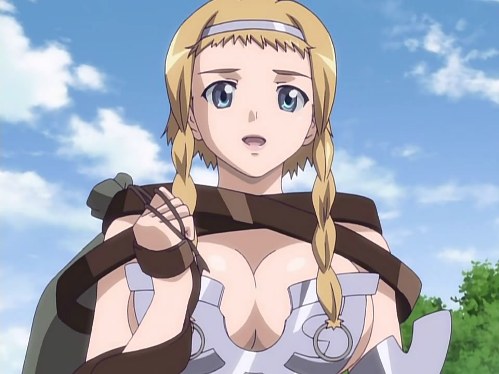
- Design (7/10) - Leina's design is deceptively simple at first glance, but when taking notice of the little details like the belt wrapped around her body, her unique shield, and decorative breast-plate, it makes for a design that may show a fair amount of skin, but is still powerful in appearance.

- Overall (6.5/10) - a good character who doesn't stand-out much other than being the main character; nothing bad about her, but nothing great either.


Elina 
- Story (8/10) - You either love or hate Elina. It is very true that Elina is an overall bad person; she looks down on anyone that isn't her sisters and treats them like trash. This attitude was created by Elina's upbringing as an aristocrat and her natural strength as a warrior; this led her to feel she was superior to everyone who wasn't a member of her family. When you think about it, it makes sense; after all, not everyone can be as humble as Leina. Speaking of Leina, she is always the catalyst of anything Elina does as a result of Elina's deep infatuation for her sister, one of Elina's most endearing traits. The story of why she loves Leina so much is great, and really helps forge her character, and it also helps bring about Elina's inner struggle where she contemplates if Leina returns her deep feelings or not, and if Claudette, perhaps, will giver her the love she desires. All-in-all, Elina, despite her evil nature, is a complex and interesting character, as well as the star of my favorite episode of the QB anime series.

- Design (8/10) - Elina's design has a playful cat theme, and it works superbly alongside her personality and fighting style. Her hook-spear is also a very unique weapon, which she uses to great effect. The fur on her collar also helps set the pompous attitude she has towards most people; a nice touch. A great design all-around.

- Overall (8/10) - a great character with a great backstory, interesting, if not sometimes humorous, personal inner struggle, and dynamic interactions with the other characters around her. 


Claudette - (9/10)
- Story (9/10) - One of the more complex characters in the series, Claudette is one of the few characters with a strong arc throughout the story. She begins as an antagonist, but slowly grows into a powerful benefactor for both her sisters, but especially Leina. Her complex relationship with Leina, Elina, her father, and Maria (Leina and Elina's mother), make for a very interesting story. It was great seeing Leina and Claudette have a happy ending to their plight and both of them moving forward in their personal goals, even if everything didn't turn out perfectly. In the end, Claudette's character arc is one of the most interesting in the QB series, and it was always exciting to see just what decisions she would make as a knight, a sister, and a person.

- Design (9/10) - In terms of design, Claudette's more stern and imposing design by rin-sin in the anime stands out stronger than her original design; even if they are very similar. Claudette easily has one of the stronger designs in the series, thanks to her red hair, unique ornamental crown, powerful physique, huge sword, and lightning powers. Her design alone shows that she is one of the most powerful warriors in the series, and I love that about her design.

- Overall (9/10) - A really stand-out character in the QB cast thanks to a powerful design and an equally powerful story that may begin in an atypical fashion but eventually comes to a good conclusion that ends Claudette's character evolution in a great way. A character with true presence.

WARNING: Tomoe and Shizuka's entries contain a major story spoiler.


Tomoe -
- Story (9/10) - one of the major reasons Leina gets heavily criticized is because of how Tomoe tends to outshine her at every turn. A foreigner in a strange land, Tomoe's journey is one of discovery and desperation, and, as a result, Tomoe's journey is equally a light-hearted journey of self-discovery and a dark fight against her own weaknesses. And it's in her weaknesses that Tomoe's character really shines, for Tomoe is, simply put, too nice. She is a great warrior, but she is a pacifist at the same time. This leads her to make many hard decisions, eventually leading to her ultimate test of fighting her true love, Shizuka, in a battle to the death, and the way Shizuka's death effects Tomoe is very well executed in the story. Tomoe's story arc may not end in the best way, but it's still a satisfying end to one of QB's most stand-out characters. "Complete" is the word that comes to mind when thinking about Tomoe's story arc.

- Design (8/10) - "Simple yet effective" is the the phrase that comes to mind when thinking of Tomoe's design. The strong contrast between red and white colors of her clothing are great, and really give her design a strong presence despite being rather simple; combine this with her long black hair and the color pallete of Tomoe's design is beautiful. Overall, a strong design that demands attention.

- Overall (9/10) - Tomoe is a character truly defined by her character arc and strong relationship with Tomoe. Her conversation with Elina during their fight is one of the standout moments of the anime, as Elina brings up the major character flaw that character's like Tomoe have: they fight and kill while still speaking of pacifism, thus making Tomoe a powerful hypocrite. Such development of character really makes Tomoe standout in terms of story, and her simple design, ironically, helps her standout as well. A great character overall.


Shizuka 
- Story (8/10) - even though she may not be an "official" character in the QB cast, Shizuka is given prominent roles in both the anime and manga. She was originally Shizuka's enemy, but after being defeated by her and hearing her ideals, Shizuka decides to become Tomoe's servant and always stay by her side. Shizuka's aloof attitude and more down-to-earth way of thinking act as a foil to Tomoe, making them a great pair. Shizuka mostly acts as a supporting character for Tomoe throughout their journey, but her character arc comes to a powerful close with her death at the hands of Tomoe. The lead-in and outcome of their fight is superbly executed, making Shizuka's death one of the best-handled I've seen. Shizuka and Tomoe's relationship is one of deep affection and would most likely have become romantic if Shizuka had lived. That said, Shizuka only dies in the anime, in all of the manga storylines Shizuka lives, and her and Tomoe have a happy ending together. Would I have preferred if Shizuka lived? Yes, definitely. But her death was not poorly executed, so I'm OK with it. 

- Design (9/10) - In terms of design, Shizuka has one of the best designs in the series. Her one long bang in her hair is my favorite aspect about her design. Her purple color scheme is distinctive and works well with her hair color; and, of course, her trademark horns became a major symbol within the series thanks to her powerful death. 

- Overall (8/10) - In the end, Shizuka was mainly a supporting character, thus she didn't really standout on her own much, but she was a  very important part of Tomoe's character, not just in the anime but in the manga as well. She's a fun and lively character and acts as a great foil to Tomoe. Combine all of this with a great design, it's no wonder she's a fan favorite of many, and her and Tomoe are constantly seen as one of the better couples of the series. It's also worthy to note that unlike many characters like her, Shizuka is not defined by her death, it is impactful, yes, but it is far from what most remember most about her; and I think that's shows how great of a character Shizuka is.


Sunday, September 2, 2012

Thought Venting - Vol. 2

- I hate how whenever I say I like Queen's Blade or explain why I like QB so much, I always feel like whoever is reading it thinks I'm joking or setting up for some punch-line. Not much I can do about it, but it's still kinda annoying. Luckily there are some folks out there who also watch Queen's Blade for the plot and characters like I do, so the whole situation doesn't bother me too much.

- Am I the only person who thinks the Jak series is much, much better than the Uncharted series on almost every level. I wish Naughty Dog continued the series on the PS3 like Insomniac did with the Ratchet series.

- I am really sick of Metroid: Other M still getting hate from people. I understand that the game was a lot of change to take in at once, but I wish people would at least respect the game for what it did so well, which was nearly everything. You don't have to like a product, but at least respect the product and those who made it when the product is so well made.

- I don't care what people say, The Fairly Oddparents is funnier than its ever been. I love nostalgia as much as the next guy, but its not so hard to admit when something new is better than it used to be.

- I hate what the new Teenage Mutant Ninja Turtles show on Nickelodeon looks like. It could still end up having some good writing and stories, but the visuals of that show are terrible, imo.

- The sports genre is SO perfect for shonen manga. The underdog rising up to beat the tougher opponent, the intensity of the "battle", and the emotional friendships among the colorful people you meet; all of it meets with the sports genre so well. Nothing gets me pumped like a great sports manga.

- I really wish great games weren't so rare these days. I won't go and say "videogames suck now", because we still get some stellar stuff, though it is mainly from Nintendo. Regardless, I miss the N64, PS1, GC, and PS2 days when there was a lot more options for a gamer to sink their teeth into; nowadays, you either have to really expand your tastes or wait 6 months or more for a game perfectly suited to your tastes.

- If Dragon's Crown does not have a trailer and an info dump at Toyko Game Show, I am going to rage pretty hard. On that note, after TGS, expect either a raging post or a fanboy post from me on the subject of Dragon's Crown.

- I'm listening to the Queen's Blade Rebellion soundtrack right now, and it is truly superb; seriously, its movie-level stuff. Masaru Yokoyama is a genius.

- I'm happy that the fighting genre has come back in full force, but I hope we see more unique stuff like P4A and Skullgirls in the future instead of just Street Fighter and Vs. style fighters.

- I really like Skullgirls, and I'm not entirely sure why. I feel like I've known these characters for a long time and yet it's only been a little over 6 months since SG came out. Maybe because SG characters and style remind me so much of Batman: The Animated Series, and I get a strong sense of nostalgia from it. Well, whatever it is, I like every aspect about SG, and I hope to see a lot more of these characters in the future.

- So, Lightning Returns: Final Fantasy XIII was just announced, and I actually don't have too much to say about it. I'm really intrigued by the new gameplay ideas and how Square will execute them, and the focus on Lightning makes me relieved after FFXIII-2. Of course, we don't know too much at the moment, so I won't make too many assumptions. At the moment, I'm excited to see what happens, but I won't get my hopes too high.


Well, here's hoping this year's Tokyo Game show is gonna be amazing. And to wrap up, here's a beautiful track from the Queen's Blade OST:


I love this track because it really reminds me of how character-driven the story of QB was and how there were many highs and lows to the character's relationships with one another without ever getting cliche or angtsy; it was just good, straight-forward story-telling.

Saturday, August 18, 2012

Let's talk about Queen's Blade

Warning: this is basically a useless post; I just vent my thoughts on Queen's Blade at the moment.

So, a new series has been added to the Queen's Blade saga called "Queen's Blade Grimoire". And, that got me thinking: the Queen's Blade IP has lasted quite a while, covered many mediums, and doesn't look to slowdown anytime soon. So what has made QB such a successful franchise? Is it the fanservice/ecchi element? I don't think so; while it is definitely part of the series' popularity, a series can't survive on ecchi alone. Rather, I think what has made the series last is my favorite aspect of the series: the characters. Each character in the QB series is designed by a different artist, with a few exceptions like F.S and Eiwa who have designed several characters. Because of this the characters all have very distinct looks, and combine this with distinct personalities and stories for each character, and you've got a melting pot for some great character interaction. And that's where the series shines the most: the way the characters interact is superb and makes for some interesting, fun, and dramatic interactions. So, in many ways, QB's popularity works in a similar fashion to fighting games and how they become popular.

Another interesting aspect of the QB series is how it encompasses many different mediums, beginning as a combat book game alongside stories written on the main website, then an anime, then several manga series, and then videogames; and that's just the first series. But, I won't ramble much on what QB is; rather I'll just get to why I love the series (in all its forms) so much, despite being someone who usually hates fanservicey/ecchi anime/manga.

It's the characters. I love character-focused stories. From slice-of-lifes to grand personal oddyseys; I love when a stories main drive and entertainment comes from a large cast of characters, and QB's cast is one of the best I've ever come across, thanks heavily in part to all of the artists who created the characters and writers who write the stories that bring all of these characters together. The fact that the entire cast consists of women is also a big reason why I enjoy QB so much, more specifically, it's why I enjoy the character interaction so much. For you see, in mediums of entertainment, when men and women are put into the same group it is almost mandatory that romance has to occur, and often times it is full of angst and takes away from what it good about character interaction and just sours the entire experience (see The Legend of Korra). Queen's Blade has none of that. All of the character interaction in QB is golden; characters have clashing ideals, form rivalries, are sworn enemies, love each other, and fight each other. Much of the anticipation that comes from an upcoming event in the story comes from the simple fact that x is going to meet y. With such a diverse cast, the simple act of two QB character simply meeting constitutes excitement, and I love that about the series.

In all honesty, I wish the series didn't have such ecchi content to it, because then perhaps more people would watch/read it, but, then again, the fanservice probably brings in as many people as it does scare off, so I suppose it's a double-edged sword. Honestly, I don't have much of a problem with the ecchi factor, as I find it to be well executed most of the time, as it is mainly used as a way of showing physical damage on a character during battle, and the more clothes that are ripped, the more damage has been put upon a character, and if blood is actually slipped, then that brings about an even more extreme situation. I find this type of execution to battles welcome, as it allows the characters to all use weapons and fight without restraint while still keeping the show from getting very violent, thus keeping it enjoyable to watch in a Saturday morning cartoon kinda way. And that's a big reason why I love QB: it's light-hearted. The stories of some characters can get pretty dark, but it never goes too far, nor does it become so light-hearted that serious situations cannot be taken seriously. The most obvious situation to point out being the death of Shizuka, which is one of the most well handled deaths of a main character I've ever seen in anime, manga, or any other medium. Whether it was a good idea to kill off Shizuka or not is something I still think about, but the way it was executed and why it occurred were very well written and executed visually; as it is a very sad moment, and for an ecchi show to create such a moment truly convinced me that QB was not an ecchi anime, rather it was an adventure anime that happened to have ecchi in it. And I think that's how the people behind QB see it as well, because the QB series continues to expand its world setting, develop its characters, and have a pretty great plot to flow alongside the characters.

In the end, I think QB is a series that deserves respect alongside the judging glances it gets. And, you know, it actually gets both. There are many out there like myself who enjoy QB for its plot and characters, while there are those who enjoy it just for the fanservice, and I'm fine with that. I look forward to Queen's Blade's future and the characters and stories to come.

Monday, July 30, 2012

Thought Venting

OK, so here's a post where I'm going to bring up a wide variety of topics that I was going to make into full posts, but couldn't develop them further enough.

- NiGHTS into Dreams is one of the best ideas in gaming history. The art design is spectacular, especially in how it blends real-world settings with dream-like worlds in order to convey the story further; plus, NiGHTS design is one of the best character designs out there. The story set-up is also great in how it brings up realistic problems that kids might deal with at around the age of 12, whether it be a recital or just having a parent who works a lot; I love how relatable it all becomes from start to finish. And then there's the soundtrack; absolutely superb, one of the best ever. The compositions for the NiGHTs games are fantastic and work alongside the art design to create a truly amazing setting. Then, there's the game design: for a game that revolves around dreams, creating a sense of flight utilizing the then-revolutionary control stick, was a superb idea. The only problem with this series was it's gameplay, which just wasn't very deep or fun. Thre probably isn't much that can be done to save this series outside of a full redesign of the gameplay, but I truly respect this series for having creators that really put a lot of heart into it's presentation and "feeling".

- I don't hate FFX and Panty and Stocking (anime) anymore. Now, don't get me wrong, I still don't like either of them, but over the last couple weeks I've come to be a lot more recessive when it comes to opinions, both mine and others. Basically, people like what they like, and creators will always make what they like, so basically everything that is made, be it videogame, anime, manga, movie, etc., there will always be people who like it. As such, my opinion doesn't really mean anything except for it's use in casual conversation. Thus, what's the point in hating something? So someone here's my opinion and decides to hate it themselves? What's the point in spreading hate? Nothing, that's what. So, yeah, I'm back not hating anything; there's plenty I don't like, but, hey, who cares? Don't worry, be happy.

- Is yuri slowly becoming more acceptable in anime? Lately, I've been seeing a lot more yuri subtext in anime, and not just niche anime, but big ones like Moretsu Pirates and Rinne no Lagrange; Pirates even had a canon yuri couple, and two on-screen kisses. Plus, with the popularity of YuruYuri and the now famous "unofficial" yuri couples of various anime like Mio/Ritsu in K-On, or Konata/Kagami in Lucky Star; will it not be long before we have more canon yuri relationships in anime? Only time will tell, but we all know which side I'm voting for.

- Final Fantasy VII is not over-rated. Over-time, FFVII has become less of a videogame famous for popularizing the JRPG in the West, and more of THE game to discuss when it the subject of over-rated videogames is brought up. Honestly, I find it strange to discuss a game that released 15 years ago in such a conversation. I mean, you won't hear anyone bring up the original Super Mario Bros. or A Link to the Past in such conversations, so why FFVII? Anyway, FFVII is a superb game, and, imo, should be considered a classic and no longer have its quality put on trial, mainly due to the game's age.

And, on the same subject, when it comes to discussion of older games, I hope that people aren't talking about such games without actually playing them. It's easy to find FFIV-IX in many places these days. If you really want to discuss such games, why not play them? You may be surprised how well they hold up. Just as I was when I played FFIX for the first time two years ago and it instantly became one of my favorite games ever.

- Can we start analyzing games more fully? Too many times I've seen critical reviews that applaud a game for its graphics or production values while practically ignoring its faults in gameplay and/or execution. The worst example of this occuring, imo, is with Bioshock; where the game truly did deserve the applause it received for its atmosphere, but it definitely didn't deserve as much for it's gameplay and story.

- Okami is still my favorite game of all time. But, Metroid: Other M is really getting more points with me over-time. Actually, I'm becoming more fond of several games more as they age; noteworthy ones being Muramasa: The Demon Blade, Grimgrimoire, Odin Sphere (yes, I've only come to love Vanillaware games more), FFIX, and SoulCaliber V. Though, I'm pretty sure the reason is because of how disappointed I've been with videogames the past two years.

- PlatinumGames is beginning to disappoint me. Bayonetta and Vanquish were two games that I flooded with praise when they first came out, but, imo, they haven't aged too well, especially Bayonetta. Now, don't get me wrong, I do greatly enjoy both games, but they really haven't held up as well as Viewtiful Joe and Okami have. Mainly due to VJ and Okami feeling like very full experiences, while Bayonetta and Vanquish were games that needed sequels to feel full. At the end of the day, I find the creative team now known as Platinum to have been better when they were Clover Studios; I don;t know what changed over the years, but I hope they go back to their more charming days. Hopefully, Project P-100 will reignite that Colver fire from those bygone days of old.


That's it for this one. I'll probably do more of these as time goes on, as I have a lot of ideas and opinions floating around.

Tuesday, July 17, 2012

Why I don't talk about sexism in games/manga/anime

I'm going to get this out of the way right now: no, I don't think that sexism in gaming is a topic that shouldn't be talked about, nor do I think the people who criticize such elements in videogames/manga/anime are in the wrong. That said, this post is about why I don't write about such things in this blog, even when it seems like something relevant to what I'm writing about. Now, this isn't a subject that I completely ignore. I do talk about it from time to time in forums and with my friends, but only when it it brought up; rarely, am I the one to bring up this topic, and the reasoning as to why is what this blog post is about.

Now then, the reason why I don't discuss sexism in gaming comes down to only two points:

1) I don't get it.


What do I mean by that? Well, simply put: I don't get what counts as sexist and what doesn't most of the time. Now, of course, there's the obvious stuff where women are objectified and disrespected, but it seems that sometimes the line blurs between what is OK and what isn't. For example, why is it that a character like Samus is ridiculed for her portrayal in Metroid: Other M, but Juliet Starling's character portrayal in Lollipop Chainsaw is just fine? Why is it that Nami and Robin in One Piece are criticized for their clothing in One Piece, but the female characters in Fairy Tail aren't? Why is it that I am a pervert for watching Queen's Blade, but suddenly I'm cool for watching Panty & Stocking with Garterbelt?

I'm not looking for an answer for these questions, because I know that answer: that's just how it is. There's no fighting against the vocal majority. Some things are established as fine and good before they're even released, while others are ridiculed far after they see release. Why? Well, my guess is that the reasoning behind if something is OK or not comes not from the people who do know what they're talking about and should be determining if it's OK or not, but rather, the vocal majority that lies within the sea of fandom known as the internet. If a fanbase is larger than another, it doesn't mater what the smaller fanbase says, the larger fanbase's opinion is what the majority of people will see and hear, and thus it will soon become fact. It's in this sea of chaos that is thousands (if not millions) of people's opinions that I just find myself not understanding the logic of this chaos. Why is it that Panty & Stocking, an anime that literally made me sick to my stomach, is a cool and awesome anime to watch? I don't know. And that's the answer I find myself coming to when faced with the many other questions that delve into subjects like portrayal of female characters and sexism. I don't get why some things are OK and others aren't. And, you know, I'm fine with that. I have my own values and opinions on the subject of sexism, and I stand by them. I feel that as long as I stand by my own opinions, I'm doing fine. I'm not going to change my values just so I can try to understand something that confuses me; after all, in doing that I'd feel like I'm betraying myself in a way, and, furthermore, I basically just don't care much. I mean, yes, I respect women very much, but as I said in my fanservice discussion post a while back, we have to understand that these are creations of fantasy and there are limits to how much fantasy can be limited and criticized. This leads to my second point ...

2) It doesn't matter.


Now, don't get me wrong, discussion on the subject of sexism and portrayal of women in games has made great strides in how women are portrayed in the entertainment medium, but what needs to be understood is that there are limits as to how much can change. Just because female characters are getting more respect in the media most people see, doesn't mean there won't always be manga like ToLoveRu and Air Gear that but T&A center stage in their portrayal of female characters. "Bad Fanservice", as I called it in my previous post, is something that will always be present in all forms of social media. Sex sells; it always has and it always will. Now, I'm not saying we should tolerate everything bad with a female characters portrayal, but we have to understand that there will always be smut in the world.


These two points come together and basically form how I take in such subjects of sexism in gaming. For example, when everyone complained about Samus' portrayal in Metroid: Other M, I thought about it for a while, but ultimately came to the conclusion that I just didn't get what everyone was talking about, and whether that was due to ignorance on my part for not seeing something that was there, or ignorance on other's part for not fully understanding the story was something I just couldn't pinpoint in the sea of chaos that is the internet and a vast amount of people's opinions. But, in the end, it didn't matter, because the majority group had spoken (on the internet at least) and the game was labeled as a poor representation of Samus and her character. Do I disagree? Of course. Does anyone really care? No. And for that reason, I don't really care. I know it's the coward's way out, but that's just how I feel about the subject. I have my own views and I stand by them, but I don't plan on dealing with the madness that is the internet in order to voice such opinions. That may seem hypocritical to say because I'm writing this in a blog on the internet, but, in all honesty, I don't really expect anyone to take my views to heart, as I'm doing this to basically vent my thoughts, not to make a statement.

Now, I'm not saying that people should just sit back and let the entertainment medium do as they like when it comes to the portrayal of women. I'm just saying that I have no place criticize such matter because I am simply too ignorant on the subject itself, too far flung from the sea of chaos that is the internet, and simply too set in my own views on the subject that I really have no place to criticize the subjects of sexism and portrayals of female characters. Thus why I don't discuss the subject. I'm not ignoring it, but I don't believe me discussing the subject will do much good.

Bottom Line: people can like what they like and hate what they hate, and that includes me. I like Samus' portrayal as a female protagonist with weaknesses and strengths in Metroid: Other M, and I hate Panty & Stocking for being a perverted mess of teenage boy fantasies with female characters who are simply sex-crazed sluts. I don't get why people don't like Samus' character portrayal, nor do I understand why the anime Panty & Stocking has such a large fanbase, but, in the end, it doesn't matter, because anime like P&S will always exist, and fanboys will always hate change in videogames. These things will never change. I may disagree, but such opinions on the internet just don't fly; so, I'm damned if I do, and damned if I don't. Sure, there's a world out there where if I try my damnedest, I might get some people to understand my opinion, but, for a normal guy like me, that's just too much work. I'll leave that people like femalefrequency @ Youtube.

In the end, all I gotta say is: don't worry, be happy.


Vanillaware and Immediate Satisfaction

It's no secret that I love Vanillaware-developed games. And over time, I have only come to love and appreciate them more and more; not just for story and graphics, but gameplay design as well. However, I have come to wonder why I love these games so much; after all, they aren't the best games in terms of gameplay, and their content can be really small in comparison to other titles, but, hey, for games made by only around a dozen people, I think they can be forgiven for that. But, after reflecting upon my time with their games, I figured out why I enjoy Vanillaware's games so much: immediate satisfaction.

In many games I've played, even those I have come to enjoy the most, there is often the problem of "long-term satisfaction", where the player must go through a lot of, let's call it "work", to get to what they really want. This "work" is stuff like traversing across a large overworld in an RPG having to deal with many random battles in order to get to a dungeon (the actual goal), or having to fight many weak enemies in order to get to a boss fight or story section. Many mission-style games have this type of "long-term" satisfaction where a player has to compelte many monotonous and boring missions before getting to take on a more interesting and challenging mission. These "work" sections of a game are often padding or "fluff" for games that would have a very short length without them. The end result is "long-term" satisfaction where the player has to perform chore-like sections of gameplay in order to get to the sections of gameplay/story that they really want. 

Now, this style of gameplay isn't always bad; for example, traversing an overworld can be fun if it is beautiful or filled with many interesting things to do, such as the overworlds of A Link to the Past or Okami. Or a game can allow for exploration that will lead to benefits for the player, such as in Metroid games. However, if possible, I prefer my game experiences to be very focused affairs, where nothing is kept from me or left dangling in front of me as a tease; rather what I want is given to me right away and the game just keeps on delivering throughout the entire experience. Of course, a game isn't going to give you the best weapons/upgrades at the beginning, nor is the story going to be at its best right away, but I don't expect a game to begin boring and then get interesting later; rather a game should begin interesting and only improve upon those humble beginnings. 

Case in point: Vanillaware games. Vanillaware games are a superb example of "immediate" satisfaction games, for they provide everything for the player immediately throughout the entire game experience. While Grand Knights History can be seen as an exception to this rule, it's multiplayer-focused game design slightly exempts it from criticism as a "long-term" satisfaction game, which, again, isn't a bad thing, but in GKH's case, the "long-term" works alongside the "immediate", but that's another discussion entirely. So here, I will focus on Vanillaware's other games which show great examples of "immediate" satisfaction game design. This is due to there being nothing superfluous or unnecessary in the game design of Vanillaware's games. Everything is presented for the player in an easy-to-learn fashion, and yet Vanillaware's games still have a lot of depth. The end result is game design that is very satisfying but doesn't require a ton of grunt work to fully obtain. 

The best way to go about this is by using examples. In Odin Sphere, for example, there is a unique leveling up system that splits the players health and attack power into two separate meters, and the way to level up these two categories is to either eat food to level up a character's health or absorb psyphers to level up one's attack power; and it all revolves around the use of pysphers, which are dropped by fallen enemies. Obtaining food and leveling up one's weapon is done by rationing how one uses the psyphers dropped by enemies, and while this may seem complicated on paper, once set up in the game, it couldn't be simpler, as it simply revolves around utilizing the assets set directly in front of the player. The player never has to worry about saving psyphers for later because there will be more enemies to defeat, nor does the player have to worry about saving items for a later time because there will be many more later. The game design of Odin Sphere was built around using what was given to the player immediately, rather than the player worrying if a particular item would be needed an hour later, or if it was the right time to level up one's weapon. Granted, there is some strategy in choosing which meter to upgrade and saving food for the Pooka Kitchen to make more complicated dishes, but it was never done with the mind-set of having to save an item for something far later in the game. This game design of "living in the moment" is what Vanillaware games truly do best.

Grimgrimoire showed "immediate" satisfaction in how it wasted no time in getting the player into the story and never really hand-holding the player; even the tutorials are directly integrated into the story itself. Grimgrimoire also held nothing back in terms of how deep the gameplay got, but the player was never forced into using complex strategies for winning; rather, everything was given to the player, but only a certain amount was asked for. This makes for a game design that doesn't require any grinding or superfluous amounts of practice; rather it was simply a game design that said: if you play well you will reap the rewards by a high ranking and beating the opponent faster, if you play poorly, you can still succeed but it will be a bumpy ride for you. What I'm getting at is that Grimgrimoire's game design provides everything for the player but doesn't ask too much of the player in return, thus resulting in a fairly unfrustrating game. 

Muramasa was a game with long treks across a world map, but it never felt dull or repetitive; this is because, like Odin Sphere and Grimgrimoire, it's game design gave the player everything right away. In Muramasa, all manner of attacks and combos were possible right in the beginning; of course they grew overtime as the player got more swords and special attacks, but the player was still given a lot right at the beginning. As a result, the long treks across the world map, and the battles that took place there, never felt repetitive or like "work", because they could all be played out differently thanks to the player being given all their assets in the beginning. In many other action-RPGs I've played, the game design was always a grind, because the player was only given a few attacks to work with in the beginning of the game, and while that increased overtime, it was done in such a slow pace that all the new attacks the player was given overtime would become repetitive themselves. Muramasa doesn't suffer from such "grinds" and instead is a smooth and satisfying stroll. 

What this "immediate" satisfaction provides is a very satisfying game design thanks to a lack of superfluous game design ideas, such as unnecessary stat parameters, annoying side-quests, or long grinds in gameplay just to be good enough to reach a satisfying part in the gameplay. Games should never feel like a chore, and Vanillaware games never do, they are always direct and simple in design, yet often hold much depth beneath the surface, and it's that game design quality that keeps me always coming back to their games and enjoying them every time.

As a disclaimer, not all games that execute "immediate" satisfaction well are great games, just as not all games that have "long-term" satisfaction are bad games. For example, Spiderman: Shattered Dimensions and Transformers: War for Cybertron execute "immediate" satisfaction very well, but aren't truly amazing games due to weak gameplay, and games like Dragon Quest VIII and Chrono Cross may have "long-term" satisfaction execution, but they're still two of the best games ever.